

Real-Time Data Fusion for Situational Awareness in Naval Operations: Engineering Principles and Integration Challenges
A warship moving at 30 knots through contested waters generates thousands of sensor readings per second. The question is never whether data exists — it is whether the right picture emerges from that data fast enough to matter. That gap between raw sensor output and actionable situational awareness is precisely where naval engineers spend careers.
Why Situational Awareness Is the Operational Cornerstone of Naval Engineering
Situational awareness (SA) is the foundation of every consequential decision made aboard a naval vessel, and building systems that reliably deliver it is fundamentally an engineering problem. Mica Endsley's three-level SA model — perception of environmental elements, comprehension of their meaning, and projection of future states — maps directly onto the functional requirements engineers must satisfy when designing shipboard systems.
Tacticians decide; engineers determine what decisions are even possible. If the sensor suite cannot detect a low-observable contact, or if the display presents conflicting track data 8 seconds too late, the tactical picture is already compromised before a single order is issued. This is why maritime domain awareness (MDA) is not a soft operational concept but a hard engineering deliverable with measurable latency, accuracy, and coverage specifications.
Naval engineering conferences consistently return to SA as a cross-cutting theme precisely because it touches every subsystem: sensors, networks, processing, displays, and the human operator. Engineers who treat SA as someone else's problem — a software or doctrine issue — tend to build systems that technically function but operationally disappoint.
What Real-Time Data Fusion Actually Means in a Naval Context
Data fusion in naval systems is the process of combining information from multiple, heterogeneous sources to produce a unified, higher-confidence picture of the operational environment — and it is categorically different from simple data aggregation. Aggregation collects; fusion correlates, resolves conflicts, and infers.
The standard engineering vocabulary for this field comes from the JDL Data Fusion Model, originally developed by the US Joint Directors of Laboratories and now widely referenced across NATO naval programs. Its six levels provide a common framework:
- Level 0 — Sub-object data processing: signal-level conditioning and feature extraction
- Level 1 — Object refinement: track formation, state estimation, identity attribution
- Level 2 — Situation refinement: relationships between objects, threat assessment
- Level 3 — Impact assessment: consequences of detected situations on own-ship mission
- Level 4 — Process refinement: adaptive sensor management based on fusion outputs
- Level 5 — User refinement: cognitive and interface factors affecting operator use of fused data
Most shipboard implementations concentrate engineering effort at Levels 0–2, where the computational and latency challenges are most acute. Levels 3–5 are increasingly discussed at ship control systems symposia as AI-assisted processing matures, but they remain the less-solved half of the problem for most naval fleets.
Sensor Architectures and the Challenge of Heterogeneous Data Streams
The core engineering difficulty in naval data fusion is not processing power — it is sensor heterogeneity. A modern surface combatant may simultaneously operate 2D and 3D surveillance radars, hull-mounted and towed-array sonar, Automatic Identification System (AIS) receivers, electro-optical/infrared (EO/IR) sensors, and Electronic Support Measures (ESM). Each modality speaks a different data language.
Radar returns arrive as range-Doppler plots with update rates measured in seconds. Sonar produces bearing-only or bearing-frequency data with update rates that may stretch to minutes. AIS provides cooperative identity data but only for vessels that transmit — and adversaries do not. EO/IR gives high-resolution imagery but is range-limited and weather-dependent. ESM detects emissions without requiring active transmission, but its geolocation accuracy depends on geometry and dwell time.
Fusing these streams requires solving several simultaneous engineering problems: temporal alignment (sensors update at different rates), coordinate registration (each sensor has its own reference frame and error model), and data quality weighting (how much to trust a degraded sonar contact versus a strong radar return). Getting this wrong produces ghost tracks, missed associations, or — most dangerously — false confidence in a track that is actually two separate contacts merged into one.
Track Management, Correlation, and the Real-Time Processing Constraint
Track management and correlation is where data fusion theory meets operational reality hardest. The fundamental task — deciding whether two detections from different sensors represent the same physical object — sounds straightforward until you are doing it for 200 tracks simultaneously, in real time, with incomplete data.
Two main association approaches dominate naval implementations. Sensor-to-track association takes a new sensor detection and determines which existing track, if any, it belongs to. Track-to-track association combines independently maintained tracks from different sensors or platforms into a single fused track. Both approaches rely on probabilistic gating and assignment algorithms — nearest-neighbor, joint probabilistic data association (JPDA), or multiple hypothesis tracking (MHT) — each with different computational costs and performance trade-offs under dense contact environments.
The latency and real-time processing constraint is where many fusion architectures fail in practice. "Real time" in naval SA does not mean instantaneous — it means fast enough to support the decision cycle. For air defense, that threshold may be under 2 seconds from detection to fused track update. For surface picture compilation, 5–10 seconds may be acceptable. These latency budgets must be allocated across the entire processing chain: sensor dwell, data transport, fusion computation, and display refresh. Engineers who design each stage in isolation often discover at integration that the cumulative latency exceeds the operational requirement.
Integration with Combat Management and Ship Control Systems
Fused situational data only creates value when it flows cleanly into the systems that act on it — primarily the Naval Combat Management System (CMS) and the ship control layer. This integration is where interoperability engineering becomes as important as fusion algorithm quality.
A CMS relies on the fused track picture for weapon assignment, fire control handoff, and threat prioritization. Ship control systems use environmental and own-ship data — speed, heading, sea state — that must be synchronized with the tactical picture for maneuvering decisions. When these layers operate on different data models or update at incompatible rates, the result is a system where the display shows one reality and the weapons system is responding to another.
Legacy fleet constraints make this worse. Many naval vessels carry combat systems that were designed before modern fusion architectures existed. Integrating a new sensor or a network-centric data link into a 20-year-old CMS often requires translation layers that introduce latency, reduce data fidelity, or both. This is a recurring discussion topic at the Royal Institution of Naval Architects and similar professional bodies, where engineers working on mid-life upgrades share hard-won lessons about what integration actually costs.
Human-Machine Interface Design for Fused Situational Displays
HMI design in naval data fusion is an engineering discipline, not a UX afterthought. The quality of the fused picture is irrelevant if the operator cannot interpret it correctly under stress, in degraded conditions, with 40 other tasks competing for attention.
The core tension is between information completeness and cognitive load. A display that shows every fused attribute of every track — confidence values, sensor contributors, association history — is technically comprehensive and practically unusable. Operators under time pressure default to heuristics; if the display design does not support those heuristics, they work around the system rather than with it.
Engineering decisions that appear to be purely display choices have direct operational consequences. Color coding for track confidence, alert thresholds for track quality degradation, and the spatial layout of contact symbology all affect how quickly an operator reaches Endsley's Level 2 SA — comprehension. Naval engineering conference tracks on human factors consistently show that operator workload is as much a system design variable as processor utilization. Both have budgets; both can be exceeded.
Current Engineering Frontiers and Conference Discourse
The active debates in naval data fusion engineering are visible in the presentation tracks of events like the International Naval Engineering Conference and ship control systems symposia. Three areas dominate current discussion.
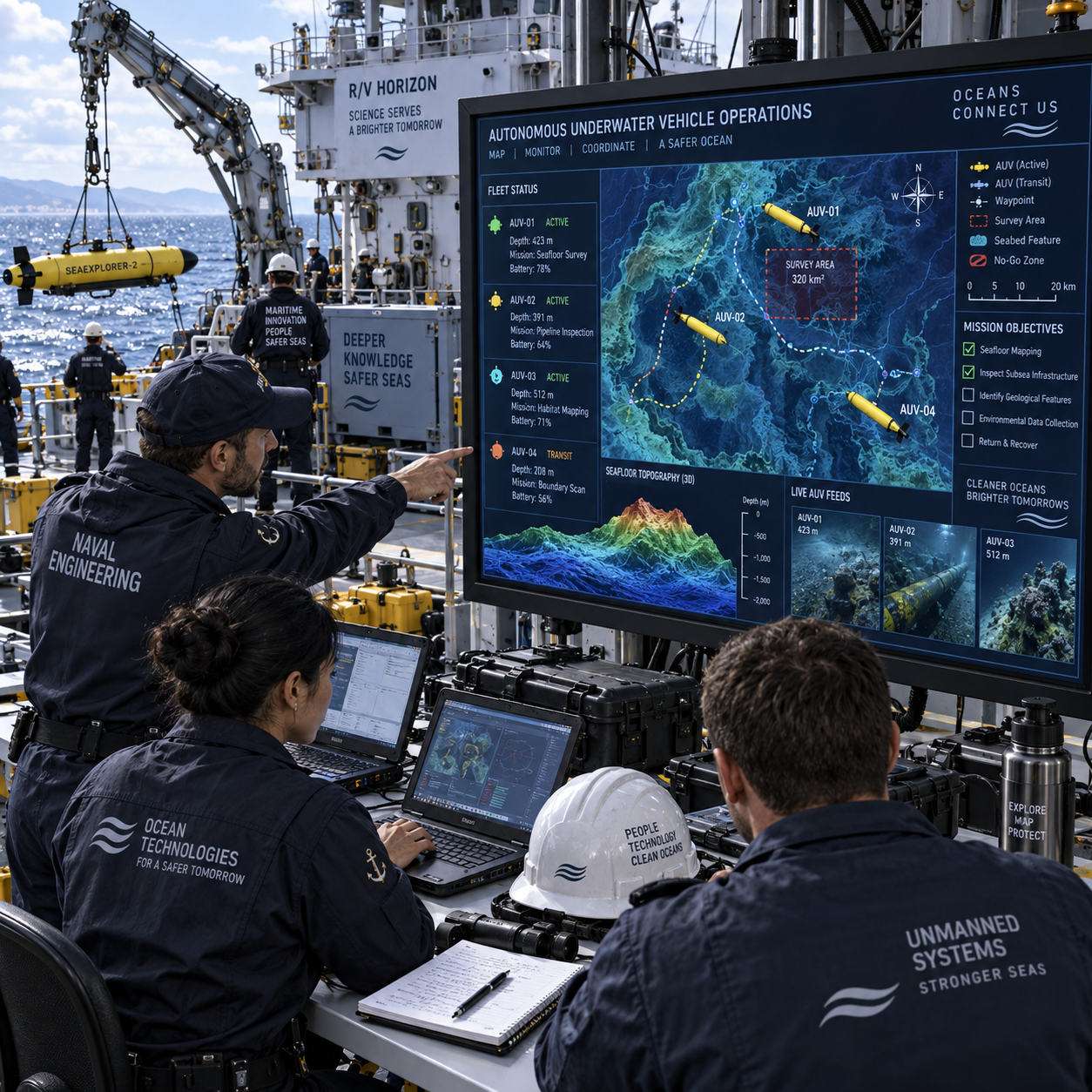
First, distributed fusion architectures — moving from centralized fusion nodes to networked fusion across multiple platforms — raise new questions about data sovereignty, bandwidth management, and what happens when the network degrades. Second, machine learning approaches to track classification and anomaly detection are attracting serious engineering interest, though the validation and certification challenges for safety-critical naval systems remain largely unsolved. Third, the integration of space-based sensors and unmanned systems into the shipboard fusion picture is expanding the scope of what "sensor heterogeneity" means, creating new association and latency problems that existing architectures were not designed to handle.
Engineers presenting at these conferences tend to be most credible when they lead with the constraints — what their architecture cannot do, and under what conditions it degrades — rather than the capabilities. The naval engineering community is technically literate enough to distrust presentations that only show the best-case scenario. That honest engineering culture is one reason conference discourse on data fusion has remained grounded even as the underlying technology has accelerated.
Frequently Asked Questions
What is the difference between data fusion and sensor fusion in naval systems?
Sensor fusion typically refers to combining outputs from multiple sensors of the same or similar type to improve detection quality. Data fusion is broader — it integrates information from sensors, databases, intelligence feeds, and network sources across all levels of the JDL model, including identity, situation, and impact assessment. In naval CMS design, sensor fusion is usually a subset of the wider data fusion architecture.
How does the JDL model apply to shipboard combat management architectures?
Most CMS implementations map directly to JDL Levels 0–2. The signal processing chain handles Level 0; the track management module handles Level 1; threat evaluation and weapon assignment logic handles Level 2. Levels 3–5 are less formally implemented in most current systems, though adaptive sensor management (Level 4) is increasingly present in modern radar and sonar management software.
What are the main latency thresholds that define "real time" in naval SA systems?
There is no single threshold — it depends on the threat timeline. Air defense fusion typically requires end-to-end latency under 2 seconds. Surface picture management may tolerate 5–10 seconds. Subsurface tracking, given sonar update rates, may work with longer cycles. The engineering requirement is to match fusion latency to the fastest decision cycle the system must support.
How do naval engineers validate a data fusion system before operational deployment?
Validation typically combines hardware-in-the-loop simulation using recorded or synthetic sensor data, scenario-based testing against known track geometries, and human-in-the-loop exercises to assess operator performance under realistic conditions. Metrics include track initiation rate, false track rate, association error rate, and latency under load. Live-sea trials against cooperative targets provide final validation, though they cannot cover all threat scenarios.
Why is HMI considered an engineering — not just a UX — problem in naval data fusion?
Because display design decisions directly constrain system performance. Alert thresholds, track symbology density limits, and update rates are engineering parameters that affect both the processing architecture and operator workload simultaneously. Getting them wrong can degrade SA even when the underlying fusion algorithm is performing correctly. Naval engineering standards, including those referenced in NATO naval interoperability guidelines, increasingly treat HMI requirements as first-class engineering specifications rather than post-design additions.