

Digital Twin Technology for Ship System Simulation and Testing
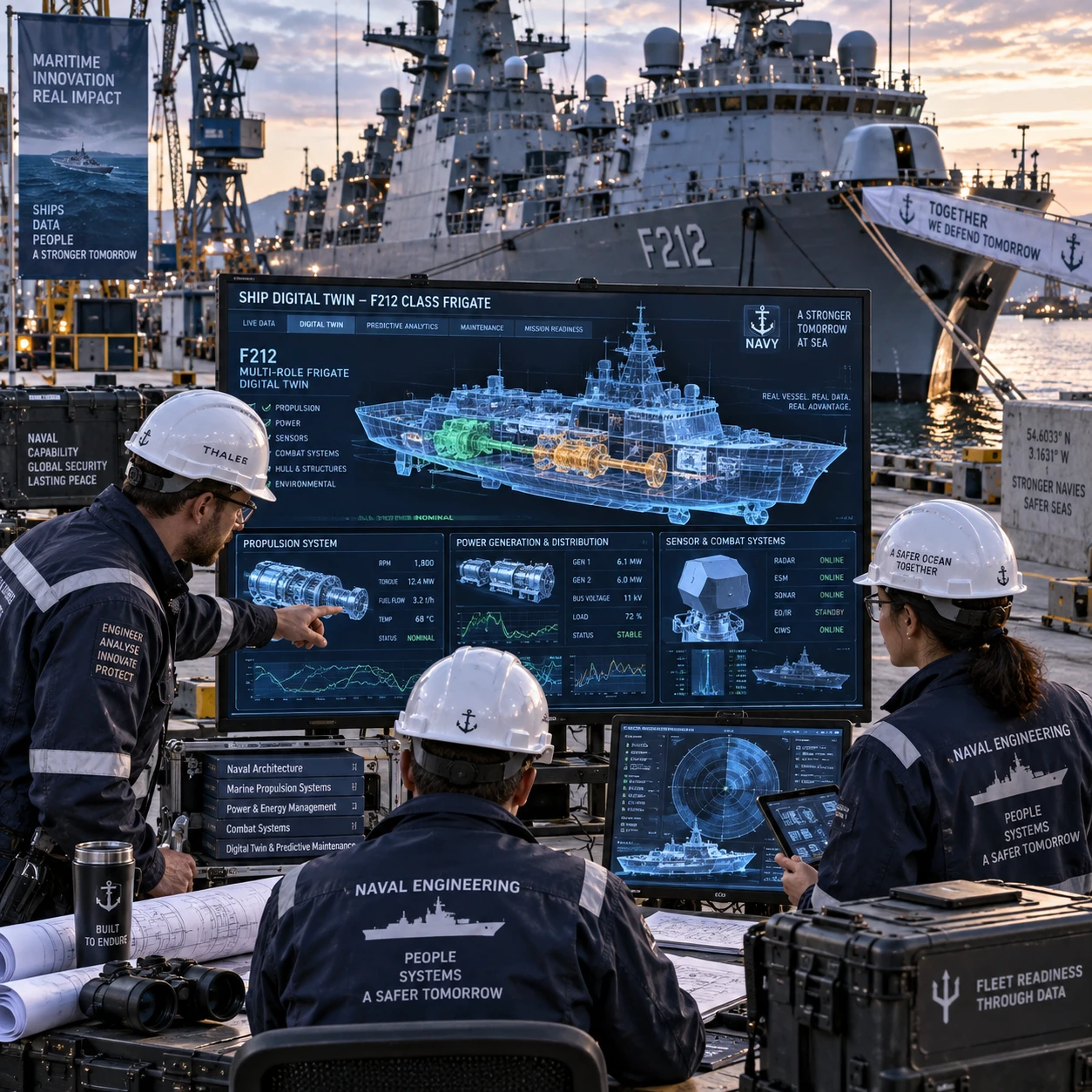
Ship systems are increasingly complex, interconnected, and expected to perform reliably through long service lives. Digital twin technology gives naval engineers a way to connect system models with information from physical equipment, supporting simulation and testing from early design through operation.
A digital twin can help teams explore how propulsion, electrical power, cooling, or control systems respond to changing conditions. Its value depends on sound engineering models, useful operational data, and careful validation. It complements physical tests and sea trials; it does not automatically replace them.
What a Digital Twin Means in Naval Engineering
A ship-system digital twin is a digital representation of a physical system that is maintained or updated using information about that system. In naval engineering, it may represent a single component, an integrated system, or a defined part of a vessel.
A standalone simulation model can predict behavior under specified inputs, but it may not receive data from the ship after the simulation ends. A digital twin adds a connection to the physical asset, commonly through sensor readings, equipment logs, inspection findings, or other operational data. That connection can be continuous, periodic, or limited by the ship’s network and security architecture.
The term is used for different levels of capability, so engineers should ask what the twin actually includes. Does it represent physical behavior, update from real equipment, or support decisions? A useful definition specifies the system boundary, data sources, model purpose, and update frequency. Without those details, a “twin” may be little more than a 3D model or a conventional simulation with a new label.
For a naval project, the distinction matters because teams need to know which decisions the model can support. A twin designed to monitor a pump’s vibration is different from one intended to test how a ship’s power network responds to a generator failure.
How Ship-System Digital Twins Are Built
Ship-system digital twins are built by combining an engineering model, data from physical equipment, and software that links the two. The design must also define how system information is integrated, managed, and protected.
Development usually begins with a specific engineering question. For example: Can the cooling system maintain required flow when a pump is unavailable? That question helps set the model’s scope and fidelity. A component-level model may capture pump performance and temperature, while a system model may also represent piping, control logic, loads, and interactions with other machinery.
Engineers then connect the model to suitable information about the physical system. Physical sensors may measure temperature, pressure, flow, vibration, voltage, or rotational speed. Operational data can also come from control systems, maintenance records, equipment configuration databases, and operator reports. Sensor readings are useful only when their units, timestamps, operating context, and quality are understood.
Software handles data exchange and model execution. It may bring together engineering tools, onboard systems, shore-side analysis environments, and databases. The integration approach should respect the ship’s architecture: not every model needs direct access to a control network, and many projects can use an approved one-way or delayed data transfer.
- Define the purpose: Name the system, decisions, and operating conditions the twin will address.
- Build the model: Select physical, logical, or data-driven methods suited to the question.
- Connect evidence: Map sensor and maintenance data to the model’s variables and equipment configuration.
- Control versions: Record model assumptions, software versions, and changes to the ship system.
More data and higher model fidelity can improve usefulness, but they also increase integration, computing, and assurance demands. A focused model with trustworthy inputs is often a better engineering tool than a broad twin whose outputs nobody can verify.
Simulating and Testing Ship Systems
Digital twins support ship-system simulation and virtual testing by letting engineers examine defined conditions before exposing equipment to them on a ship. They can inform design reviews, commissioning plans, and scenario analysis, while physical tests remain necessary for evidence the model cannot provide.
During design evaluation, teams can vary loads, component settings, or environmental conditions to compare system responses. A propulsion model, for instance, could help examine how changes in operating demand affect fuel use, shaft power, and cooling requirements. An electrical-system model could explore load sharing, switching sequences, or the consequences of losing a generator. These results depend on the assumptions and data used; they should be treated as engineering evidence, not as a guarantee of real-world performance.
Virtual testing can also exercise control logic and failure scenarios that may be difficult, disruptive, or unsafe to reproduce during commissioning. Engineers can check whether alarms appear in the intended sequence or whether a backup configuration behaves as specified. Hardware-in-the-loop testing, where real controllers interact with simulated system behavior, can add useful realism when the interfaces and timing are modeled appropriately.
Before a vessel enters service, a digital twin may help organize commissioning tests by identifying expected signals, operating ranges, and scenarios for investigation. It can also provide a common reference for design engineers, system integrators, and test teams. However, a virtual pass does not establish that physical equipment, installation, wiring, or shipboard interfaces are correct. Those still require inspection and testing.
Good virtual testing starts with a test question and acceptance criteria. Record the scenario, model version, inputs, expected response, and limitations. This makes results easier to reproduce and keeps model evidence distinct from physical qualification evidence.
Applications Across the Ship Lifecycle
Across a ship’s lifecycle, a digital twin can support design, commissioning, operation, troubleshooting, and maintenance by relating model behavior to the condition of physical systems. Its contribution changes as the ship moves from planned configuration to actual service.
During design and integration, teams can assess interfaces between systems and explore whether equipment selections meet expected operating requirements. At commissioning, model predictions may help identify unusual measurements or guide investigation, provided the model reflects the installed configuration. In service, operational data can support performance monitoring and help crews and engineers understand how a system behaves under different loads.
For troubleshooting, a twin can compare observed signals with modeled behavior. If cooling-water temperature rises unexpectedly, engineers might examine pump status, flow, heat load, and sensor readings together. This can narrow possible causes, but it cannot by itself determine whether the root problem is a failing component, a sensor fault, a changed operating condition, or a model limitation.
Predictive maintenance is another potential application. Trends in vibration, temperature, or operating hours may help identify changes that warrant inspection. The model can provide context by linking those trends to system conditions. Maintenance decisions still need appropriate thresholds, expert review, and confirmation from inspection or testing. A prediction is a prompt for action, not proof that a component will fail at a particular time.
Over a vessel’s service life, a well-governed twin can support lifecycle engineering by preserving assumptions and connecting design intent with operational experience. The challenge is keeping the representation aligned with modifications, replacements, and configuration changes. If the digital record diverges from the ship, confidence in its recommendations will erode.
Validation, Data, and Integration Challenges
Digital twins require model validation, reliable data, and controlled systems integration to produce results that engineers can trust. A sophisticated visualization cannot compensate for incorrect assumptions, mismatched equipment data, or unverified behavior.
Model validation compares model outputs with suitable evidence, such as component test results, commissioning measurements, or operational observations. Engineers should test across the conditions where the model will be used and document where it has not been assessed. Agreement in one operating state does not prove accuracy during a transient event or a degraded configuration.
Data quality creates another practical constraint. Sensors may drift, fail, report at different rates, or use inconsistent units. Maintenance records may describe a component differently from the engineering database. Teams need data checks for time synchronization, missing values, calibration status, and equipment identity. When information is uncertain, the twin should expose that uncertainty rather than present a precise-looking output without qualification.
Interoperability is equally important. Ship projects often involve equipment and software from different suppliers, each with distinct data formats and interface rules. Agreeing on identifiers, units, system boundaries, and exchange methods early can prevent costly rework. Cybersecurity must be part of the design as well: access controls, network separation, approved transfer paths, and software-update procedures should reflect naval requirements and the sensitivity of the information.
- Over-scoping the twin: Teams may try to model an entire vessel at once. Start with a bounded system and a decision that can be tested.
- Assuming more sensors mean better answers: More data can add noise and integration effort. Select measurements tied to model variables and engineering needs.
- Treating simulation output as proof: Virtual results do not replace required physical qualification or sea trials. State what evidence each test provides.
Implications for Naval Engineering Practice
Digital twin technology affects naval engineering practice by bringing modeling, system integration, testing, operations, and maintenance into a more connected workflow. Its success depends as much on governance and collaboration as on simulation software.
Teams should agree on model ownership, configuration control, data rights, and the evidence needed for each engineering decision. Designers, shipyards, equipment suppliers, operators, and maintainers may hold different pieces of the system picture. A shared definition of the twin’s scope and limitations helps those groups exchange useful information without assuming that every model is suitable for every purpose.
For a naval engineering conference, productive discussion can move beyond demonstrations to practical questions: Which ship systems justify a live-connected model? What validation evidence is acceptable? How should digital models be maintained after equipment changes? Which interfaces can be standardized without restricting supplier solutions? Answering these questions helps separate an impressive prototype from a dependable engineering capability.
The most credible approach is incremental. Select a system with a clear operational or test need, establish a baseline model, validate it against available evidence, and define how it will be updated. Expand only when the first application provides useful, reviewable results. That discipline lets digital twins support lifecycle decisions while keeping physical testing and engineering judgment firmly in the process.
Frequently Asked Questions
How does a ship-system digital twin differ from a simulation?
A simulation model calculates system behavior for selected inputs. A digital twin also has a defined connection to information about a physical system, such as sensor or maintenance data, and may be updated as that system changes. The connection can be periodic rather than live.
What ship systems can be represented by a digital twin?
Examples include propulsion, electrical power, cooling, fuel, pumps, and control systems. A project should select systems according to its engineering question and the availability of suitable models and data.
How is a digital twin validated?
Engineers compare model outputs with relevant test results or operational measurements across the conditions where the twin will be used. They document assumptions, uncertainty, and untested operating ranges.
Can a digital twin support testing before a ship enters service?
Yes. It can support design evaluation, control-logic checks, commissioning preparation, and virtual scenario testing before entry into service. Physical inspections, equipment tests, and sea trials remain necessary where they are required to verify the installed ship.