

Unmanned Underwater Vehicle (UUV) Control and Coordination: Engineering Principles for Naval Operations
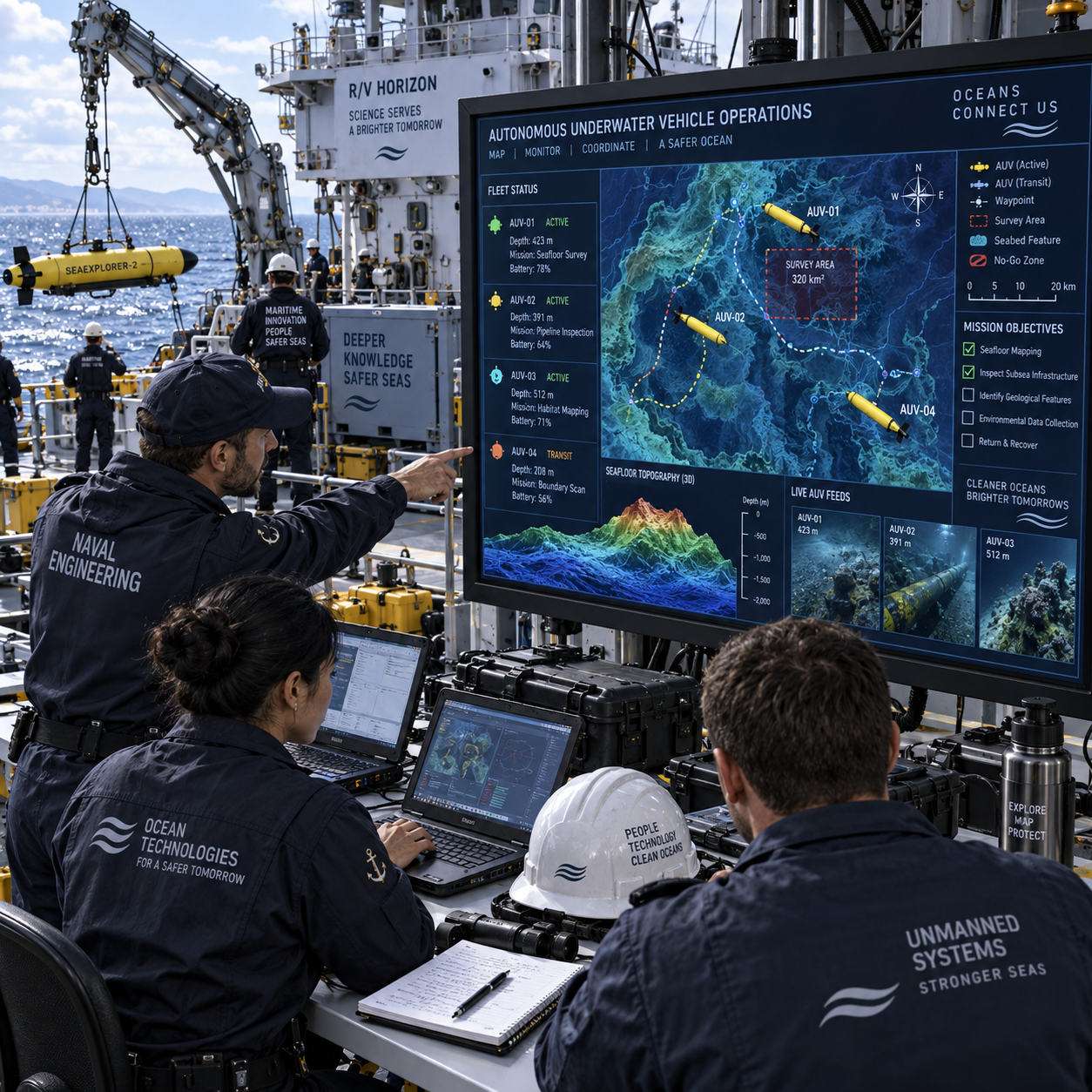
Unmanned Underwater Vehicle (UUV) control and coordination determine whether an underwater mission remains safe, useful, and recoverable when communications fade and conditions change. Unlike surface or airborne systems, a UUV cannot depend continuously on satellite navigation or high-bandwidth links. Its control system must combine autonomy, navigation, energy management, mission planning, and human supervision.
The Role of UUV Control and Coordination in Naval Engineering
UUV control and coordination connect mission objectives with vehicle behavior, allowing an underwater system to navigate safely, perform tasks, conserve energy, and return or recover under uncertain conditions. This capability supports surveillance, seabed mapping, mine countermeasures, and environmental data collection.
An Autonomous Underwater Vehicle (AUV) may spend much of a mission outside direct operator contact. Its guidance, navigation, and control software therefore has to interpret a mission plan rather than simply follow continuous commands. A typical plan may specify a survey area, depth limits, sensor behaviors, data-quality requirements, communication windows, and recovery conditions.
Control also protects the vehicle itself. Currents, variable bathymetry, suspended sediment, marine traffic, obstacles, and imperfect vehicle models can push an AUV away from its intended path. The system must detect deviations, estimate risk, and select a response that preserves both mission value and platform safety.
For naval engineering, the central issue is system integration. A highly capable vehicle still delivers limited operational value if its navigation uncertainty prevents reliable data georeferencing, its battery cannot support the planned route, or its data cannot enter a wider maritime situational awareness picture.
UUV Control Architectures and Levels of Autonomy
UUV control architectures range from continuous human-in-the-loop control to fully autonomous decision-making. Centralized systems simplify oversight, while decentralized and distributed approaches can improve resilience when communication with a command node is intermittent.
Human supervision and autonomy levels
- Human-in-the-loop: an operator approves or directly controls important actions. This can provide strong accountability, but intermittent underwater links make continuous intervention impractical.
- Human-on-the-loop: the vehicle executes approved behaviors while an operator monitors status and can intervene when contact is available.
- Supervised autonomy: the UUV manages routine navigation and task execution, escalating exceptions such as navigation degradation, low energy, or unexpected obstacles.
- Fully autonomous operation: the system selects actions within predefined constraints. This maximizes independence but demands stronger verification, fault handling, and explainability.
Centralized, decentralized, and distributed control
In a centralized command-and-control architecture, a vessel or mission computer assigns routes and tasks to individual UUVs. This approach can optimize the overall mission with a common operating picture, but it depends on connectivity and creates a potential single point of failure.
Decentralized coordination gives vehicles local decision authority. Each UUV can respond to nearby hazards or changing conditions without waiting for a central command. Distributed control goes further by allowing vehicles to share selected state information and make coordinated decisions as a group. The trade-off is additional software complexity, more difficult verification, and possible disagreement when vehicles hold inconsistent estimates of the environment.
A practical design often uses a hybrid model: centralized mission intent, local safety authority, and distributed cooperation for selected tasks. This separation makes it easier to define which decisions require human approval and which must remain available during communication loss.
Navigation, Localization, and Underwater Situational Awareness
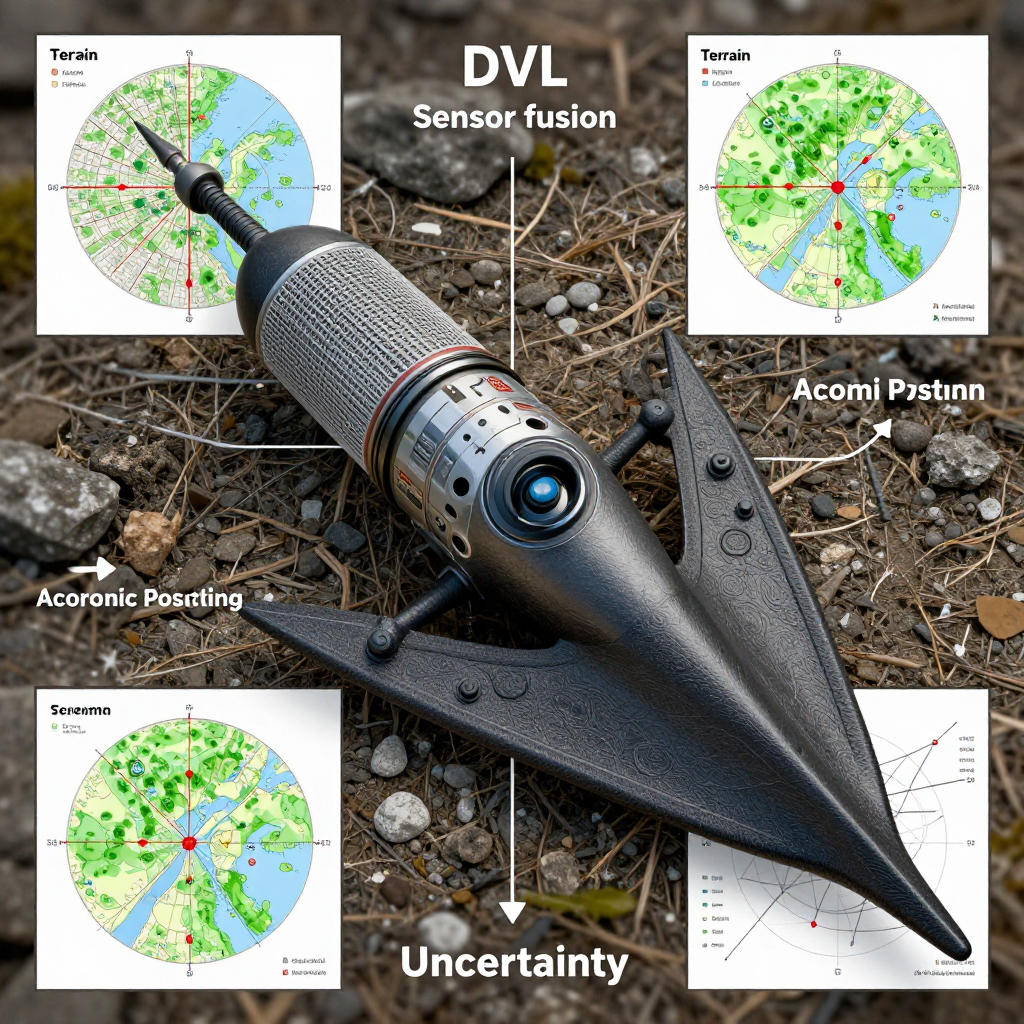
Underwater navigation and localization rely on sensor fusion because GPS signals do not normally support submerged operations. Inertial navigation, acoustic positioning, terrain-aided navigation, and environmental sensing each reduce different parts of the uncertainty problem.
An inertial navigation system estimates motion from accelerometers and gyroscopes, but its position error grows over time. Doppler velocity logs can estimate movement relative to the seabed or water column, while depth sensors and compasses provide additional constraints. Acoustic systems, including transponder-based positioning and long-baseline or ultra-short-baseline arrangements, can improve absolute localization when geometry and signal conditions are suitable.
Terrain-aided navigation compares measured seabed features with a stored bathymetric map. It can be valuable in mapped areas, although sediment movement, incomplete charts, and weak terrain relief can reduce confidence. A navigation filter combines these inputs with vehicle dynamics and sensor-quality indicators to produce an estimated state and uncertainty envelope.
That uncertainty must influence control decisions. A route that is acceptable with a small position error may be unsafe when the estimated error approaches the clearance from an obstacle or survey boundary. Maritime situational awareness therefore includes more than a map: it combines vehicle state, obstacle reports, current estimates, acoustic contacts, environmental conditions, and the confidence attached to each item.
Communication Constraints and Interoperability
Underwater acoustic communication provides the main long-range wireless link for submerged UUVs, but it offers limited bandwidth, latency, variable reliability, and susceptibility to multipath and environmental noise. UUV control must therefore remain functional when messages are delayed or unavailable.
Mission traffic should be prioritized. A short safety command, position estimate, fault alert, or request to surface may matter more than a large sensor file. Systems commonly separate low-rate command and status messages from bulk data transfer, which can occur during a planned rendezvous, at the surface, or through a support vessel acting as a gateway.
Communication protocols should define message priority, time validity, acknowledgement behavior, encryption, authentication, and actions after missed updates. A stale route command must not be treated as current simply because it eventually arrives. The vehicle should know when to continue, hold position, change depth, surface, rendezvous, or abort.
Interoperability extends beyond the acoustic modem. UUVs may exchange information with surface gateways, fixed seabed systems, support vessels, and naval command networks. Shared mission-data standards and clearly defined interfaces reduce the cost of integrating different vehicle manufacturers, sensors, and command systems. The design challenge is to share enough information for coordination without consuming the link with unnecessary detail.
Coordinating Multiple UUVs
Multi-vehicle coordination assigns complementary tasks, maintains safe separation, and preserves mission progress when vehicles encounter delays or lose contact. Effective cooperation combines formation control, cooperative navigation, collision avoidance, rendezvous planning, and adaptive task allocation.
Formation control may maintain relative geometry for synchronized sensing, communications, or area coverage. It must account for currents and vehicle performance differences rather than assuming every platform can follow the same path at the same speed. Collision avoidance should use predicted trajectories, uncertainty margins, depth separation where appropriate, and clear priority rules for conflicting maneuvers.
Mission planning and task allocation can be centralized before launch, updated by a coordinator during communication windows, or negotiated locally by the vehicles. A useful allocation method considers:
- distance and expected transit energy;
- sensor availability and data quality;
- navigation confidence and communication access;
- remaining battery and recovery requirements;
- risk created by failure or delay.
Cooperative navigation allows vehicles to improve relative estimates by exchanging observations or ranging data. Yet shared estimates can also spread errors. A robust system records the source and confidence of exchanged information and prevents one faulty vehicle from destabilizing the entire group.
Graceful degradation is a defining requirement. If one UUV loses contact, the others should not automatically wait indefinitely or continue into an unsafe pattern. They may reallocate its task, widen spacing, return to a rendezvous point, or complete a reduced mission. Swarm autonomy is therefore best evaluated by recovery behavior, not by the elegance of its normal-case coordination.
Mission Planning, Safety, and Human Oversight
UUV mission planning converts objectives into routes, behaviors, constraints, contingencies, energy budgets, and recovery plans. Human oversight remains essential because operators define intent, approve risk boundaries, and interpret exceptions that autonomy may not understand reliably.
A mission plan should specify geofences, depth and speed limits, obstacle-clearance rules, communication windows, sensor modes, abort triggers, and return-to-recovery logic. Energy planning needs reserve margins for currents, detours, loitering, localization updates, and failed rendezvous attempts. A route that is efficient in still water may become infeasible when the vehicle must fight a persistent current.
Fault handling should be layered. A minor sensor discrepancy might trigger degraded navigation, while a severe leak indication or propulsion fault may require immediate ascent or recovery. The vehicle should record why it changed behavior, what evidence supported the decision, and which mission objectives remain incomplete.
Cybersecurity protects more than confidential data. Authentication prevents unauthorized commands, integrity checks detect altered mission files, and secure update processes reduce software supply-chain risk. Safety cases should examine both malicious and accidental failures, including spoofed navigation inputs and corrupted environmental maps.
Operators need meaningful status rather than a flood of raw telemetry. Displays should show vehicle intent, estimated position, uncertainty, energy margin, communication age, active constraints, and recommended intervention. This supports informed supervision without requiring the operator to micromanage every control loop.
Research Priorities for Reliable UUV Coordination
Reliable UUV coordination research should focus on validated autonomy that remains safe under uncertainty, degraded communication, navigation error, and vehicle failure. Progress depends on realistic testing and clear evidence that prototypes can transition into deployable maritime systems.
Priority areas for naval engineering research include:
- Robust autonomy: decision policies that recognize uncertainty and select conservative fallback behaviors.
- Explainable decision-making: operator interfaces that expose intent, constraints, confidence, and reasons for replanning.
- Resilient communications: delay-tolerant protocols, adaptive message priority, and secure surface-gateway concepts.
- Digital mission rehearsal: high-fidelity simulation using bathymetry, currents, acoustic conditions, sensor faults, and realistic vehicle dynamics.
- Verification and validation: staged trials from software-in-the-loop and hardware-in-the-loop tests to controlled-water and open-water demonstrations.
- Interoperability: common mission-data models and interfaces connecting UUVs with vessels, fixed systems, and command networks.
- Human-machine teaming: supervision models that allocate authority clearly and keep operators effective during abnormal events.
Conference discussions should ask how performance is measured. Mission completion alone is insufficient. Useful measures include navigation accuracy, data validity, energy reserve at recovery, communication recovery time, collision-avoidance success, fault-detection quality, operator workload, and the proportion of mission objectives completed after a vehicle failure.
The strongest research programs treat control and coordination as a complete operational system. Autonomy cannot compensate for poor localization, and a sophisticated swarm algorithm cannot overcome an unrealistic energy budget. Field trials should deliberately include uncertainty and degraded conditions, because that is where architecture choices become visible.
Frequently Asked Questions About UUV Control and Coordination
What is the difference between UUV control and UUV coordination?
UUV control governs one vehicle’s motion, energy, sensors, and safety responses. UUV coordination manages relationships among multiple vehicles, including task allocation, communication, formation, rendezvous, and collision avoidance.
How do UUVs communicate underwater?
Most submerged UUVs use underwater acoustic communication. Because acoustic links have limited bandwidth and variable latency, vehicles exchange compact command, status, and coordination messages and transfer larger data sets through surface gateways or recovery operations.
Which navigation methods are used when GPS is unavailable?
Common methods include inertial navigation, Doppler velocity logs, depth and compass sensors, acoustic positioning, terrain-aided navigation, and sensor fusion. AUVs may surface periodically when mission design and environmental conditions permit a GPS position update.
What are the main challenges of coordinating multiple UUVs?
The main challenges are intermittent communication, localization uncertainty, limited energy, current-induced drift, collision risk, inconsistent vehicle states, and safe behavior after a vehicle fails or disappears from the network.
How can operators maintain oversight of autonomous UUV missions?
Operators maintain oversight through mission approval, geofences, authority limits, event-based alerts, interpretable status displays, communication windows, and predefined abort or recovery policies. Good supervision focuses attention on exceptions rather than continuous low-level control.