
Adaptive Control Systems for Harsh Maritime Environments
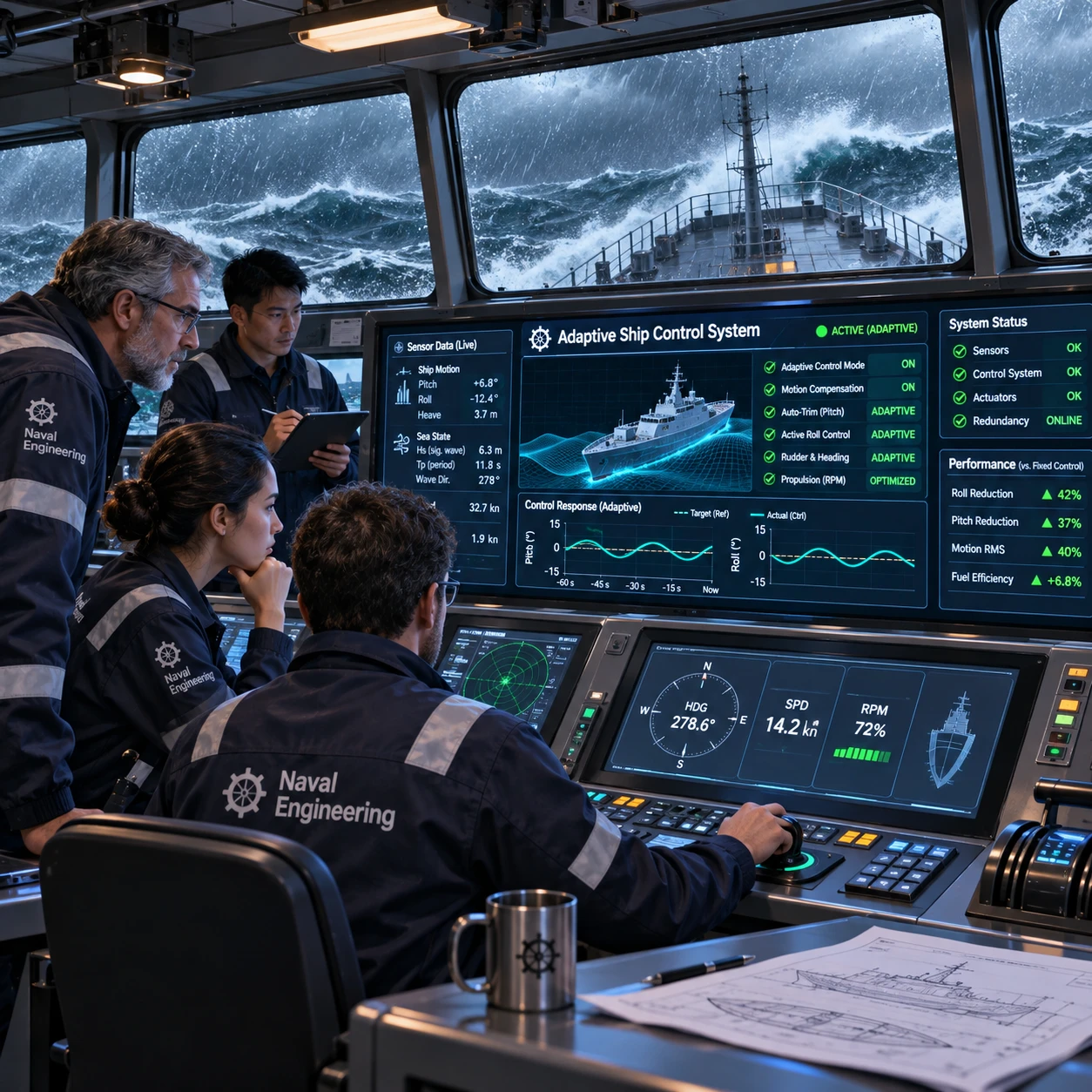
At sea, a control system must work through changing waves, wind, loading, equipment condition, and mission demands. Adaptive control systems respond to these shifts by updating control behavior as conditions or vessel dynamics change, helping naval platforms maintain performance when fixed settings are no longer suitable.
Adaptation is not a substitute for sound design, safety limits, or operational judgment. Its value depends on accurate measurements, well-defined boundaries, and rigorous validation. For naval engineers, the central question is not simply whether a controller can adapt, but whether it can do so predictably across the conditions a vessel is expected to face.
Why maritime environments challenge control systems
Maritime control systems face disturbances and operating changes that can alter vessel motion, maneuverability, and equipment response. Sea state, weather, vessel loading, and mission requirements all affect how a platform behaves and how its controllers should respond.
Waves and swell can produce roll, pitch, yaw, and heave that vary in amplitude and frequency. Wind and currents add forces that complicate station keeping, course keeping, and low-speed maneuvering. A controller tuned for calm water may behave differently when the vessel encounters a following sea or strong crosswind.
Vessel dynamics also change over time. Fuel use, cargo or mission payload, draft, hull fouling, and equipment wear can alter mass distribution, hydrodynamic response, or actuator effectiveness. In naval operations, the control system may also need to accommodate changes in speed, formation, sensor availability, or mission priorities.
These effects interact. A steering controller, for example, may need to manage course error while the rudder response changes and wave-induced yaw grows. Fixed gains can be too conservative in one condition and too aggressive in another. Yet frequent adjustment without safeguards can create instability or excessive actuator activity. That tension makes robust control and bounded adaptation essential design considerations.
How adaptive control works at sea
Adaptive control changes controller parameters or behavior in response to observed conditions, system performance, or estimated vessel characteristics. At sea, it can help a controller remain effective when disturbances or platform dynamics differ from the assumptions used during initial tuning.
A conventional controller uses parameters selected in advance. An adaptive controller adds a mechanism that estimates changing conditions or performance and uses those estimates to adjust control action. A ship-motion controller might update its model as loading changes; a maneuvering system might compensate for altered steering response. The adaptation should operate within defined bounds and preserve required safety behavior.
Common approaches include gain scheduling, model-reference adaptive control, and online parameter estimation. Gain scheduling selects among pretested controller settings based on operating regions such as speed or loading. Model-reference methods adjust controller behavior to track a target response. Online estimation updates selected model parameters from sensor and actuator data.
These approaches have different costs. Gain scheduling is relatively straightforward to review, but it depends on adequate coverage of operating conditions and sensible transitions between settings. Online adaptation can address changes that were not fully anticipated, yet it raises harder questions about convergence, stability, and how to respond when the estimates are wrong. A practical design often combines adaptation with a stable baseline controller, parameter limits, and a fallback mode.
The distinction is important: adaptation can compensate for uncertainty, but it cannot make poor sensors, inadequate actuators, or an unsafe control objective acceptable.
Key components and supporting technologies
An adaptive maritime control system combines sensors, data processing, control algorithms, actuators, and monitoring functions. Reliable adaptation depends on the complete loop: the system must observe the vessel, estimate its condition, select a safe response, and verify the result.
Sensor fusion combines measurements that describe different aspects of platform motion and operation. Depending on the application, inputs may include inertial measurement units, GNSS, gyrocompasses, speed logs, radar or lidar, wind sensors, engine data, and actuator feedback. Filtering and plausibility checks help distinguish real vessel motion from noise, dropouts, or conflicting measurements.
The controller uses these inputs to estimate relevant states and calculate commands. Data-processing units may run motion estimation, system identification, and fault detection and diagnosis alongside the control algorithm. Actuators then carry out commands through steering gear, thrusters, propulsion controls, or stabilizing equipment. Their limits matter: a control law cannot overcome insufficient authority, slow response, or mechanical degradation.
- Sensors and fusion: provide motion, position, environment, and equipment-state estimates.
- Adaptive and robust control: adjust selected parameters while maintaining stability and performance boundaries.
- Actuators and feedback: convert commands into physical action and report whether that action occurred.
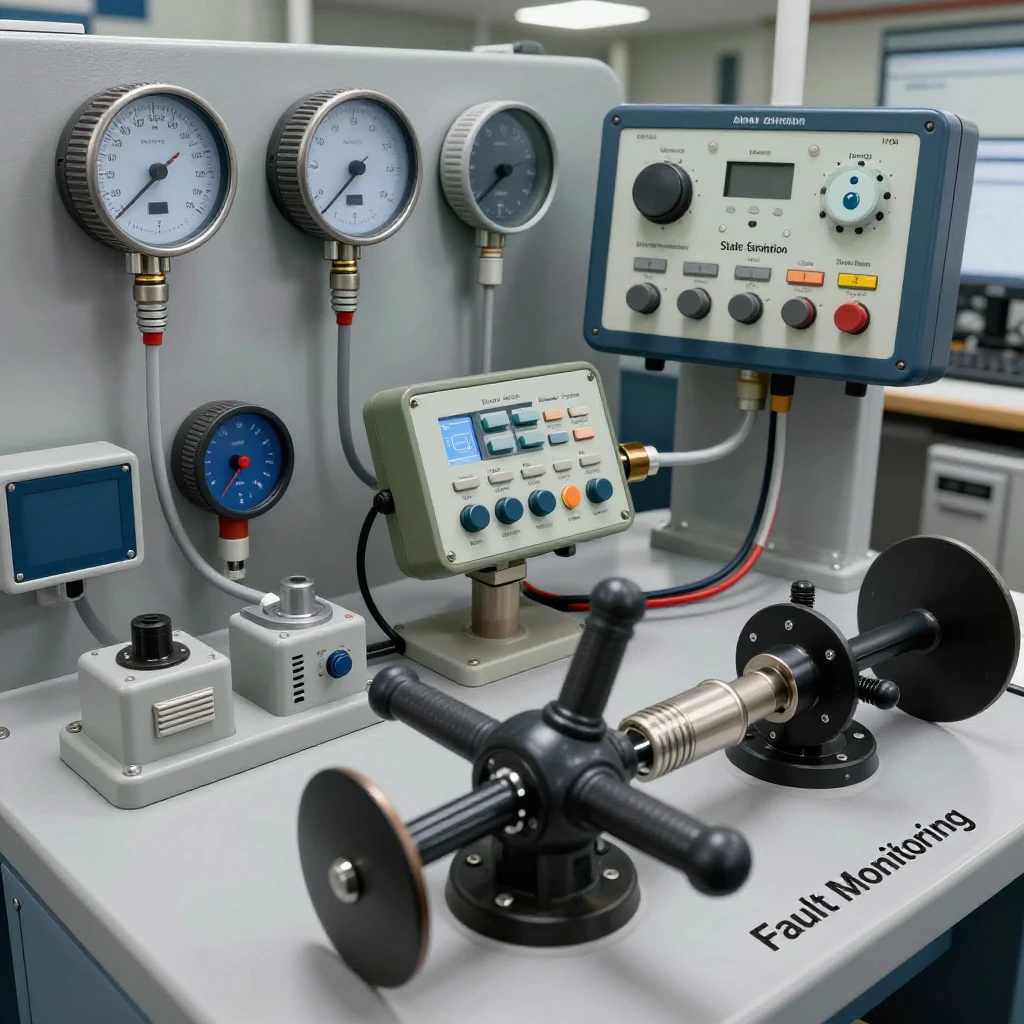
- Fault monitoring: detects sensor disagreement, actuator faults, and abnormal operating data, then supports reconfiguration or fallback.
Fault detection is particularly important because adaptation can otherwise misinterpret a failed sensor as a change in vessel behavior. A controller should identify when data quality falls below an acceptable level, stop or constrain adaptation where needed, and alert the operator. This creates a clearer boundary between normal adaptation and fault response.
Naval and maritime applications
Adaptive control can support ship motion, maneuvering, propulsion, and autonomous operation when those tasks must continue across changing conditions. Suitability depends on the vessel, mission, safety case, and maturity of the specific control approach.
For course keeping and maneuvering, adaptation may compensate for changing steering response, wind loading, or vessel speed. In motion stabilization, a controller may adjust to changes in loading or sea-state characteristics, subject to limits on actuator movement and structural loads. Propulsion control can also account for changing operating conditions, but any efficiency or performance objective must remain subordinate to machinery limits and safe handling.
Autonomous and remotely operated vessels present a further use case. Adaptive control can help maintain a desired track or heading as environmental forces shift, while higher-level autonomy handles route planning and mission decisions. These functions should be clearly separated: low-level control must preserve safe vessel behavior even when navigation inputs, communications, or remote supervision are unavailable.
Naval platforms may require these capabilities to work with distinct operating profiles, including close-quarters maneuvering, station keeping, and operations in challenging weather. The trade-off is that each added mode increases integration and verification work. A controller demonstrated on one hull form cannot be assumed to transfer directly to another, because displacement, propulsion, steering geometry, and hydrodynamic characteristics differ.
Design, safety, and reliability considerations
Safe adaptive control requires bounded parameter changes, fault-aware operation, cybersecurity protections, and clear human oversight. The system must remain predictable when conditions exceed its design envelope or its information becomes unreliable.
Engineers should define what may adapt, how quickly it may change, and which limits cannot be crossed. These limits can include actuator rates, allowable motion, propulsion constraints, and stability conditions. Robust control provides a useful complement: adaptation addresses expected changes, while robust design helps preserve acceptable behavior under uncertainty and disturbances.
Sensor degradation deserves explicit treatment. If GNSS becomes unreliable or motion sensors disagree, the controller should not continue adapting as though the vessel has simply changed dynamics. Fault detection and diagnosis should distinguish sensor faults, actuator faults, and genuine changes in the plant where possible. When confidence is low, the system may need to freeze parameter updates, switch to a verified mode, or request operator intervention.
Cybersecurity is also an operational safety concern. Unauthorized or corrupted data could influence state estimates or control commands. System architecture should protect control networks, authenticate relevant inputs, log changes, and provide a safe response to detected anomalies. Human operators need understandable alarms and a practical means to supervise, limit, or disengage adaptation.
A common design error is treating the adaptive algorithm as the entire safety solution. This happens because adaptation appears to address uncertainty directly. In practice, weak fault handling or unclear fallback logic can turn uncertainty into unpredictable behavior. Specify fault cases and fallback modes early, then test them as carefully as nominal performance.
Testing and deployment challenges
Adaptive maritime control should be tested progressively through analysis, simulation, hardware-in-the-loop testing, and sea trials. Each stage reveals different failure modes, and no single test environment can establish operational safety on its own.
Simulation allows engineers to explore combinations of sea-state disturbances, vessel dynamics, sensor errors, and actuator limits that would be difficult or unsafe to reproduce at sea. The models themselves need scrutiny: unrealistic hydrodynamics or overly clean sensor signals can make a controller appear more capable than it is.
Hardware-in-the-loop testing connects real control hardware to simulated vessel and environment models. It can expose timing issues, software integration faults, data-interface problems, and behavior under injected sensor or actuator faults. Sea trials then assess performance in the physical environment, using staged operating envelopes and clear abort criteria rather than relying on a single successful demonstration.
Legacy-system integration adds another challenge. Older vessels may use control interfaces, sensors, or data formats that limit access to real-time information. Retrofit teams should document latency, signal quality, actuator authority, and failure behavior before enabling online adaptation. A verified conventional mode may be necessary when new functions are unavailable.
Evaluation should cover more than tracking accuracy. Useful measures include stability margins, control effort, actuator duty, recovery from faults, operator workload, and behavior during transitions between modes. Reporting those measures across defined scenarios makes results more useful to other programs and supports meaningful comparison.
Research priorities for naval engineering
Naval engineering research should focus on proving that adaptive controllers remain safe, explainable, and transferable across operating conditions and vessel types. The main challenge is building evidence that supports deployment, not simply demonstrating adaptation in a favorable scenario.
Conference discussions can examine how to define and verify safe adaptation limits, how to validate models against measured sea-trial data, and how to compare controllers using repeatable disturbance scenarios. Researchers also need methods for quantifying uncertainty in sensor fusion and for deciding when a controller should adapt, hold its current settings, or fall back.
Explainability and operator trust deserve practical attention. Operators need to know what changed, why the system changed it, and whether the change can be reversed. A concise event log showing the triggering condition, parameter adjustment, and resulting control response can make trials and incident reviews more informative.
Another priority is transfer across hull forms and missions. A method tuned for one vessel should be evaluated against different displacement, propulsion, and steering characteristics before broader claims are made. Research should distinguish established techniques, such as gain scheduling with validated operating regions, from less mature online-learning methods whose safety and verification requirements remain active questions.
For conference presenters, a strong contribution pairs a control method with its operating envelope, fault assumptions, test design, and limitations. That framing helps engineers judge whether a result can support a real naval platform, and what evidence is still needed before deployment.