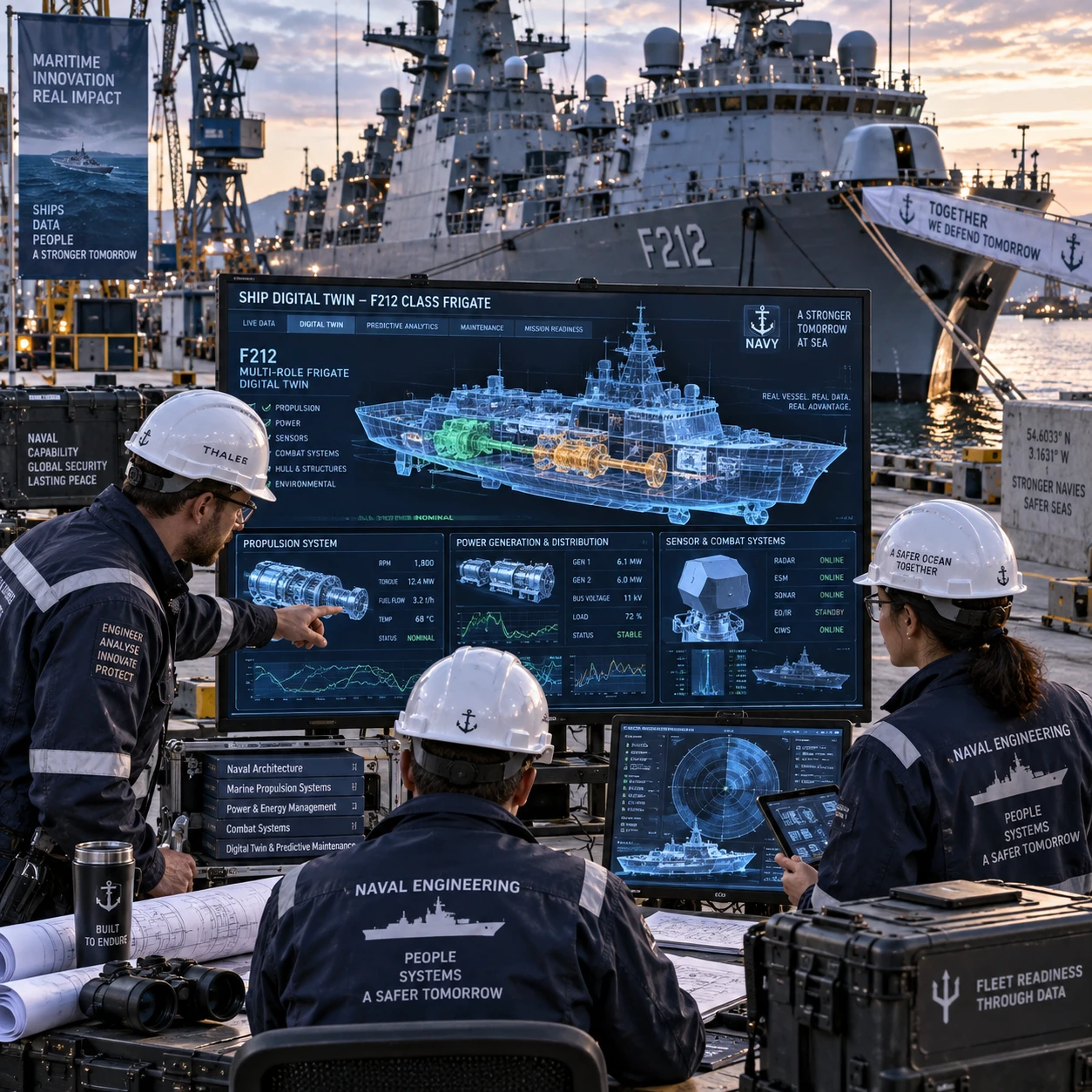


Next-Generation Propulsion Control Systems for Warships
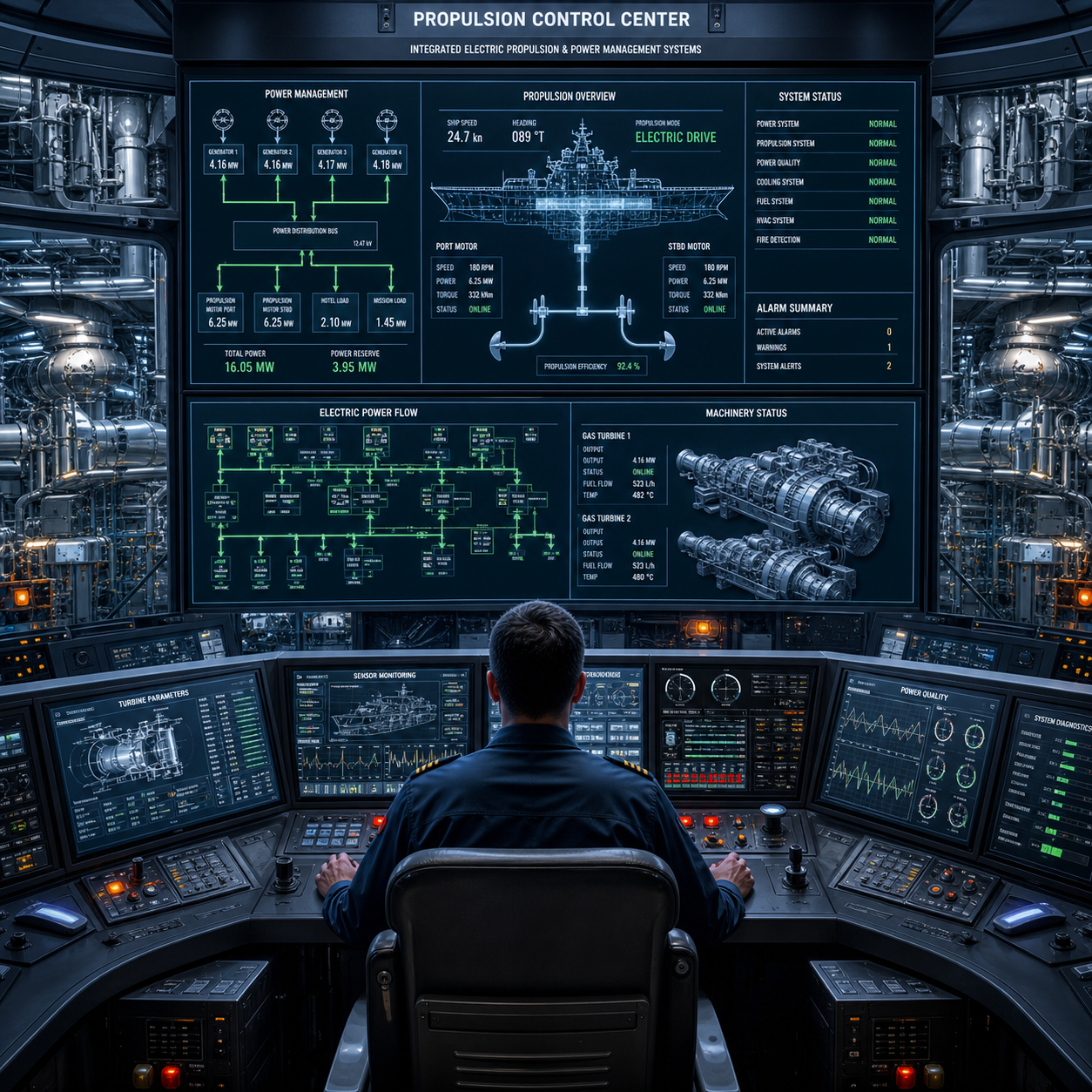
Next-generation propulsion control systems are becoming central to how warships generate power, maneuver, manage energy, and remain operational after equipment failures. The engineering challenge extends well beyond selecting a gas turbine, marine diesel engine, electric motor, or battery system. It involves coordinating machinery, electrical distribution, automation, software, communications, and human decision-making as one resilient naval platform.
For naval engineers and conference delegates, the key question is practical: how can a propulsion control system deliver responsive performance while remaining safe, maintainable, cyber-resilient, and understandable to its operators?
Why Propulsion Control Is Becoming a Strategic Naval Capability
Propulsion control is becoming a strategic naval capability because it directly influences speed, maneuverability, endurance, electrical availability, acoustic signature, survivability, and mission flexibility. A well-designed system turns propulsion machinery into an adaptable shipboard resource rather than an isolated engine function.
Modern warships increasingly depend on propulsion machinery for more than shaft power. Integrated propulsion and power systems may support sensors, communications, hotel loads, mission equipment, and future high-demand electrical consumers. Control decisions therefore affect the ship’s energy margin and its ability to respond to changing operating conditions.
Fine control of engines, generators, drives, and propulsors can improve low-speed handling and reduce unnecessary fuel consumption. Electric propulsion may also provide greater freedom in machinery arrangement and support quieter operating modes, although the acoustic result depends on motor, gearbox, hull, cooling, and structural design as a whole.
There is no universally optimal architecture. A fast surface combatant, a patrol vessel, and a large auxiliary ship face different requirements for acceleration, endurance, redundancy, volume, and power quality. The strategic value lies in coordinated control and graceful response, not in adopting a fashionable technology in isolation.
Core Architecture of a Next-Generation Warship Propulsion Control System
A next-generation propulsion control system connects sensors, controllers, machinery automation, power management, propulsion drives, operator interfaces, and higher-level ship systems through a layered architecture. Each layer should have clear authority, timing requirements, failure behavior, and cybersecurity boundaries.
At the equipment level, sensors measure shaft speed, torque, temperature, pressure, vibration, fuel flow, electrical current, voltage, and breaker status. Local controllers execute fast protective and regulating functions. Machinery automation systems coordinate engines, pumps, valves, lubrication, cooling, and starting sequences.
The propulsion control system architecture then interfaces with the power management system. Power management balances generation and demand, controls generator loading, manages bus configuration, and supports load shedding when available capacity falls. Propulsion drives regulate motor speed or torque, while an integrated bridge or machinery control room presents status, alarms, trends, and recommended actions.
Higher-level naval platform integration may include navigation, damage-control, ship-management, and mission systems. That integration must be carefully bounded. A single network failure should not remove local control of essential propulsion functions, and a noncritical information system should not gain unnecessary authority over safety-critical machinery.
Enabling Technologies and Propulsion Configurations
Enabling technologies include integrated electric propulsion, hybrid arrangements, advanced gas turbines and marine diesel engines, variable-speed drives, energy storage, and automated power distribution. Their suitability depends on hull form, mission profile, electrical demand, endurance requirements, and survivability objectives.
Integrated electric propulsion separates prime-mover operation from propulsor speed more effectively than many mechanical arrangements. Gas turbines or diesel generators can produce electrical power, while motors drive the shafts or propellers. This can simplify some machinery layouts and support flexible power allocation, but it increases dependence on power electronics, switchboards, cooling, software, and power-quality management.
Hybrid-electric propulsion combines mechanical and electrical paths. A vessel might use direct mechanical drive for efficient high-speed operation and electric motors for low-speed maneuvering or quiet transit. Energy storage can absorb transient demand and reduce the need to operate a large prime mover inefficiently. Batteries, however, introduce thermal management, fire protection, weight, volume, lifecycle, and certification considerations.
Advanced gas turbines offer high power density, while marine diesel engines commonly provide strong part-load efficiency and endurance characteristics. Variable-speed drives can improve motor and pump efficiency, yet they may introduce harmonics, electromagnetic compatibility concerns, and additional control complexity.
Automated power distribution must coordinate generators, buses, converters, propulsion loads, and essential services. Choosing higher flexibility means accepting more interfaces to validate and maintain. The control design should therefore begin with mission-based load cases, not with a component catalogue.
Intelligence, Automation, and Condition-Based Operations
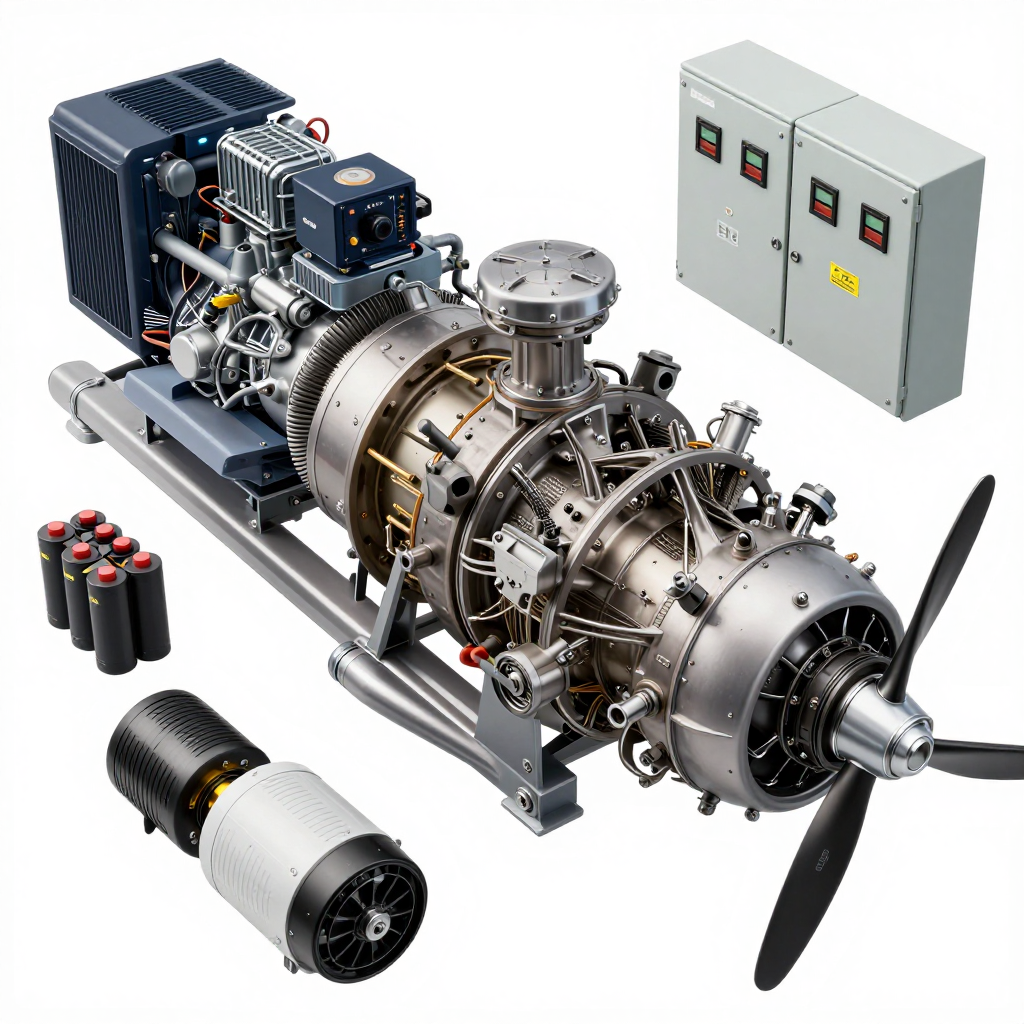
Intelligent propulsion control combines real-time monitoring, predictive diagnostics, digital twins, model-based control, automated fault detection, and operator decision support. Its purpose is to improve awareness and response while preserving qualified human authority over consequential actions.
Condition-based maintenance uses trends in vibration, bearing temperature, lubricant condition, exhaust parameters, insulation resistance, and electrical signatures to identify deterioration before a failure becomes operationally significant. A diagnostic system might flag a gradually rising vibration trend for inspection rather than waiting for a fixed maintenance interval.
Digital twins and model-based control provide a structured representation of machinery behavior under different loads and environmental conditions. When linked to live data, a digital twin can compare expected and observed performance, identify abnormal relationships, and help engineers test control changes before applying them to the ship.
Automation should be designed around authority levels. The system may automatically protect equipment, stabilize a power bus, or recommend a load shift. Operators should retain the ability to approve, reject, or override higher-level decisions, with clear explanations and event records. Poorly designed automation creates alarm floods and opaque recommendations, increasing workload precisely when the ship is under stress.
Resilience, Cybersecurity, and Safe Failure Management
Resilient propulsion control maintains essential functions through redundancy, segregation, local control, secure communications, and graceful degradation after equipment or network failures. Cybersecurity is part of this resilience because a manipulated command or misleading sensor value can be as harmful as a hardware fault.
Redundancy may involve multiple controllers, independent networks, separated machinery spaces, duplicated sensors, and alternative power paths. Fault tolerance must be matched to realistic failure modes. Replicating every component can increase cost, weight, software complexity, and common-cause risk if all redundant channels share the same design weakness.
Safe failure management should define what happens when a sensor is lost, a controller becomes unavailable, communications are interrupted, or a switchboard section is isolated. Local manual control and hardwired protection can provide recovery paths, while automated systems preserve the safest stable operating state available.
Cyber protection requires asset inventories, network segmentation, least-privilege access, secure configuration, authentication, patch governance, monitoring, and tested recovery procedures. Guidance such as the NIST Cybersecurity Framework offers useful risk-management principles, but naval systems also require platform-specific controls and operational discipline.
Environmental robustness matters equally. Vibration, shock, salt atmosphere, temperature variation, electromagnetic interference, and power disturbances can expose weaknesses that do not appear in office-style testing. Resilience is demonstrated by recovery behavior, not by a claim that failure is impossible.
Engineering and Integration Challenges
The main engineering challenges are legacy-system integration, interoperability, control-loop validation, latency, crew training, maintainability, and lifecycle support. New propulsion control technology must operate within a vessel whose machinery, networks, software, and procedures may span several generations.
Legacy interfaces often use proprietary protocols, incomplete documentation, or timing assumptions that complicate integration. Gateways can bridge systems, but every gateway adds a potential failure point and cybersecurity boundary. Open standards improve interoperability only when vendors implement them consistently and engineers define data ownership and performance requirements precisely.
Control-loop validation must account for sensor delays, actuator limits, network latency, power-electronic behavior, and changing machinery states. Hardware-in-the-loop testing can expose faults before installation. Digital twins and real-time simulation support broader scenario coverage, while dock trials and sea trials confirm behavior under physical vibration, loading, weather, and crew procedures.
Training is often underestimated. Operators need to understand automated modes, alarm priorities, degraded configurations, manual recovery, and the limits of diagnostic recommendations. Maintainability also requires accessible equipment, replaceable modules, configuration control, spare-parts planning, and software update processes that do not create unacceptable operational interruptions.
The central trade-off is clear: greater complexity can provide better optimization and flexibility, but it creates more dependencies to verify, secure, explain, and sustain. A simpler system with well-understood failure modes may outperform a more sophisticated design over its service life.
Priorities for Naval Engineering Research and Procurement
Naval engineering research and procurement should prioritize open interfaces, representative test environments, digital engineering, rigorous verification and validation, upgradeability, and lifecycle collaboration. These priorities help convert promising control concepts into dependable shipboard capability.
Conference discussions should examine several practical questions:
- Which control functions require deterministic timing, physical separation, or local fallback?
- How can open standards support interoperability without weakening safety or cybersecurity?
- What digital-twin data should remain available throughout design, construction, commissioning, and operation?
- How should hardware-in-the-loop laboratories represent faults, degraded power networks, sensor errors, and communications loss?
- Which energy-management strategies provide measurable value across realistic mission and maintenance profiles?
- How can software and control-system upgrades be introduced without compromising configuration control or crew confidence?
Procurement teams should evaluate evidence from simulation, component testing, integrated land-based testing, harbor trials, sea trials, and lifecycle monitoring. Requirements should describe outcomes such as recovery time, availability, maintainability, and safe degraded operation rather than prescribing a single technology prematurely.
The strongest path forward is collaborative. Shipbuilders, navies, classification specialists, control engineers, machinery suppliers, cybersecurity researchers, and operators each see different failure modes and usability constraints. Bringing those perspectives together can produce propulsion control systems that are efficient when conditions are normal and dependable when they are not.
Frequently Asked Questions
What makes a propulsion control system next-generation for warships?
It combines integrated propulsion and power management, advanced sensing, automation, model-based diagnostics, secure connectivity, resilient architecture, and human-centered control. The defining feature is coordinated, explainable performance across machinery and electrical systems.
How do integrated electric and hybrid-electric systems change propulsion control?
They make propulsion control an energy-management problem as well as a shaft-speed problem. Controllers must coordinate generators, motors, batteries, converters, switchboards, propulsion demand, and essential ship loads while maintaining power quality and safe operating margins.
How can advanced control systems improve warship resilience?
They can detect faults earlier, isolate damaged equipment, reconfigure power paths, preserve local control, and maintain essential propulsion through graceful degradation. These benefits depend on validated fallback modes and effective crew training.
What cybersecurity risks affect naval propulsion control systems?
Risks include unauthorized access, manipulated commands, false sensor data, malware, insecure remote maintenance, network compromise, and loss of system availability. Segmentation, authentication, monitoring, secure updates, and tested recovery procedures reduce exposure.
How should new propulsion control technologies be tested and validated?
Use a staged process that combines model-based analysis, software-in-the-loop, hardware-in-the-loop, integrated land-based testing, dock trials, sea trials, environmental qualification, cybersecurity assessment, and lifecycle monitoring. Testing should include faults, degraded networks, operator actions, and recovery procedures.