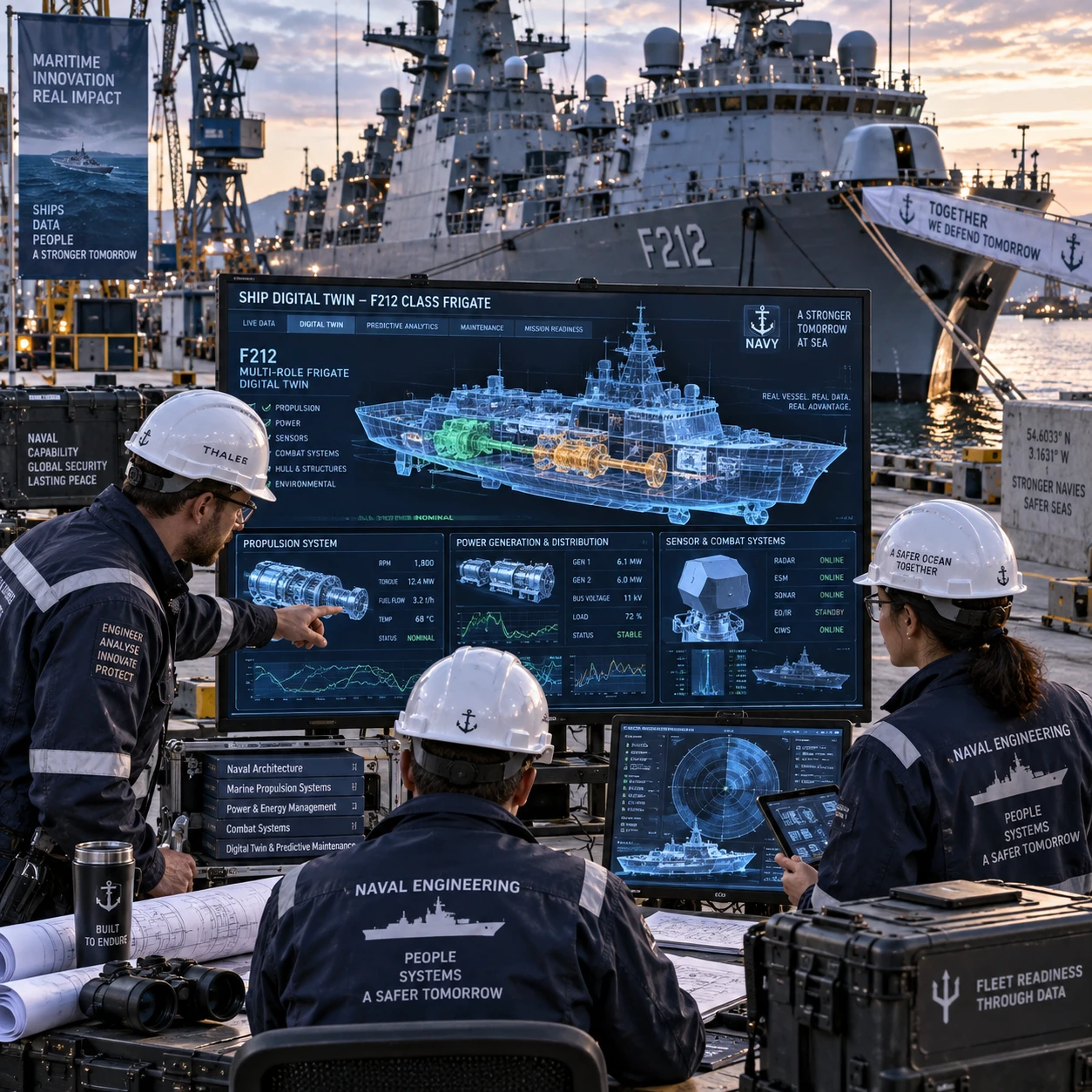


AI and Machine Learning in Naval Command and Control Systems: Engineering Challenges and Emerging Capabilities
The Evolving Role of C2 Systems in Modern Naval Operations
Command and Control systems are the architectural backbone of naval vessels — integrating sensor data, communications, weapons management, and crew decision-making into a coherent operational picture. As threat environments grow in speed and complexity, the traditional C2 model built around human reaction cycles is under pressure.
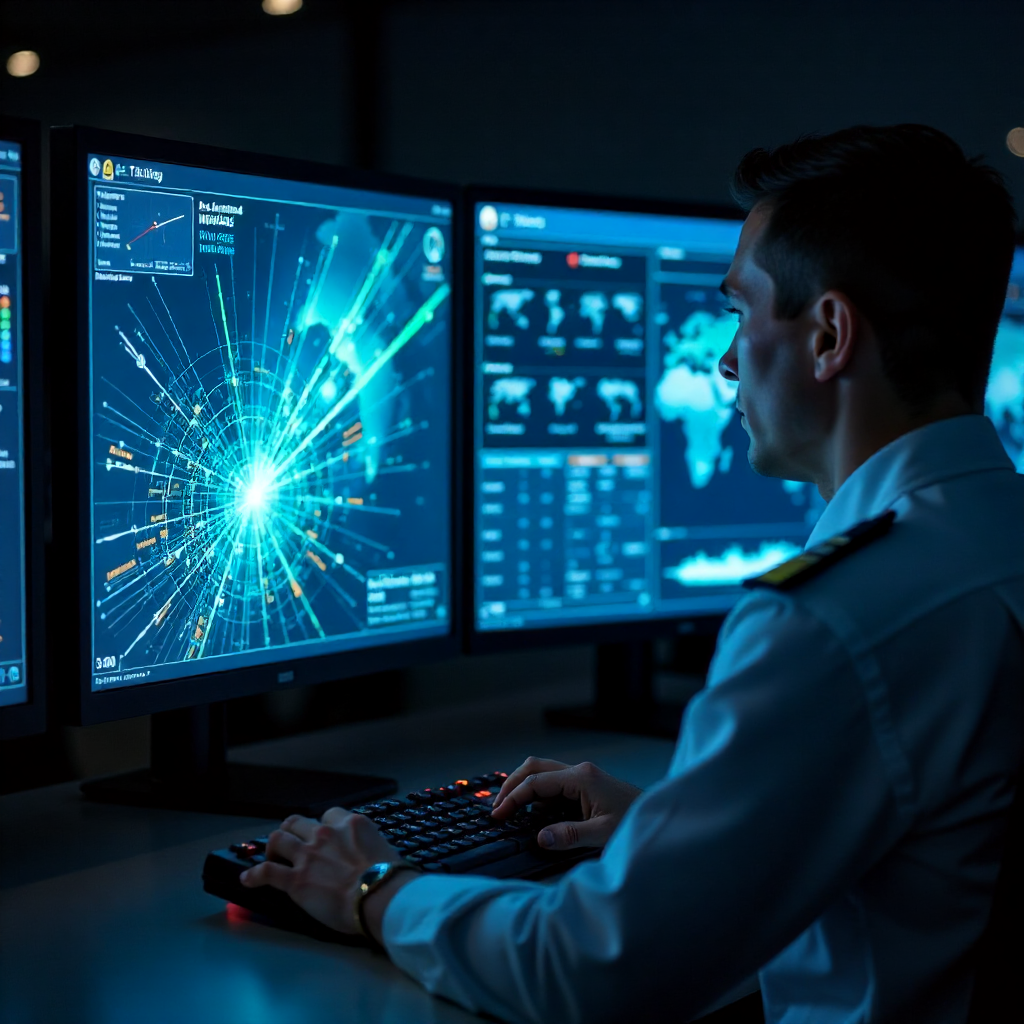
Modern naval engagements can involve supersonic anti-ship missiles, coordinated drone swarms, and electronic warfare attacks that unfold on timescales of seconds. A surface combatant may be processing data from dozens of sensors simultaneously while managing concurrent threats across multiple domains: air, surface, subsurface, and cyber. The cognitive load on command teams has increased substantially, and the margin for delayed decisions has narrowed.
This is the engineering problem driving AI integration into naval C2 and Combat Management Systems. The goal is not to replace the command team but to compress the time between detection and decision — and to do so reliably in contested, degraded environments where data quality is never guaranteed.
Where AI and ML Are Currently Applied in Naval C2
AI and machine learning are being applied across several discrete technical domains within naval C2, with sensor fusion and threat classification representing the most mature areas of deployment.
Sensor fusion is perhaps the highest-value application. Naval vessels carry arrays of radar, sonar, electro-optical, and signals intelligence sensors that each produce incomplete pictures of the battlespace. ML models — particularly those using deep learning architectures — can correlate detections across sensor modalities, resolve track ambiguities, and produce a consolidated recognized maritime picture with higher confidence than rule-based fusion algorithms alone.
Track management benefits directly from this: automatic track initiation, classification, and prioritization reduce the manual workload on operators and improve the quality of the tactical picture. In high-clutter environments, this difference is operationally significant.
Beyond situational awareness, current applications include:
- Threat classification and intent estimation from behavioral signatures
- Optimized weapons assignment and engagement sequencing
- Predictive maintenance using onboard sensor streams and anomaly detection
- Logistics and supply chain optimization for fleet operations
- Natural language interfaces for system queries and report generation
Most of these are decision-support functions — they present ranked options or flagged conditions to human operators rather than acting autonomously. That distinction matters, and it shapes how systems are designed, validated, and certified.
Autonomous Decision Support vs. Full Autonomy: Where the Line Is Drawn
The dominant framework in naval C2 design is human-machine teaming, not autonomous action. Current doctrine across major navies maintains human authorization for lethal force — a constraint that has direct engineering implications for how AI is integrated into Combat Management Systems.
The spectrum runs from pure advisory tools (the system recommends, the operator decides) through supervised autonomy (the system acts within defined parameters, with human override) to full autonomy (the system acts independently). Deployed naval AI sits firmly at the advisory and supervised-autonomy end of that spectrum for safety-critical functions.
This is not simply a policy choice — it reflects genuine engineering constraints. A system that recommends a course of action can tolerate occasional errors; a system that executes autonomously under fire cannot afford them at the same rate. The asymmetry between the cost of a missed threat and the cost of a false engagement creates a design problem that current ML validation methods have not fully solved.
The human-machine interface layer becomes critical here. Engineers designing C2 consoles must present AI-generated recommendations in formats that operators can evaluate rapidly and override confidently. Poorly designed interfaces can make human oversight nominal rather than real — operators who never challenge AI recommendations aren't exercising meaningful control, even if the authority chain formally requires their input.
Key Technical Challenges for Engineers
Deploying ML in shipboard C2 environments introduces engineering constraints that don't appear in commercial AI deployments, and several remain genuinely unsolved.
Real-time inference under bandwidth and computational constraints is the first. Naval platforms have limited space, power, and cooling budgets. Running large inference models on edge hardware in a shipboard environment is a different problem from running the same models in a data center. Model compression, quantization, and hardware-aware design choices are active research areas for this reason.
Model validation in safety-critical environments presents a different class of problem. Standard ML evaluation metrics — accuracy on held-out test sets — do not translate directly to safety assurance. A model that performs well on historical data may fail on novel threat signatures or in environmental conditions outside its training distribution. Naval C2 engineers need validation frameworks that characterize out-of-distribution behavior systematically, not just average-case performance.
Adversarial robustness is closely related. ML models can be deliberately deceived by adversarial inputs — sensor spoofing, electronic masking, or coordinated deception — in ways that rule-based systems are not. Designing for adversarial robustness in a threat environment where the adversary is actively motivated to find failure modes requires different thinking than standard ML safety engineering.
Finally, integration with legacy C2 architectures is a persistent practical constraint. Most in-service naval vessels carry systems built to older data standards, with interfaces that were never designed to consume ML model outputs. Middleware integration, data pipeline standardization, and incremental capability insertion — rather than wholesale platform replacement — define the actual engineering programme for most navies.
AI Assurance, Explainability, and Certification
Explainability in naval AI is primarily an engineering and procurement requirement, not an abstract ethical concern. Explainable AI (XAI) matters because operators who cannot understand why a system produced a recommendation cannot effectively override it when it's wrong — and procurement authorities cannot certify what they cannot characterize.
A threat classification system that outputs a confidence score with no supporting reasoning gives an operator little to work with when the score seems wrong. An XAI-enabled system that surfaces the contributing sensor detections, behavioral signatures, and comparative library matches allows an experienced operator to validate or challenge the output in seconds. That difference is operationally meaningful and increasingly a stated requirement in naval capability specifications.
Assurance frameworks for AI in safety-critical systems are still maturing. Defense standards bodies and naval procurement agencies are actively developing guidance — drawing on work from aviation certification (where ML assurance has been debated longer) but adapting it to the naval context. Engineers working on C2 procurement today are operating in an environment where the standards are incomplete, which makes early engagement with standards bodies and participation in forums like INEC technically valuable, not just professionally useful.
Cybersecurity Considerations for AI-Enabled C2
ML components in C2 systems introduce cybersecurity attack surfaces that conventional network security frameworks were not designed to address. The two most significant are model poisoning and adversarial input attacks on deployed models.
Model poisoning targets the training pipeline: if an adversary can inject corrupted data during training or fine-tuning, they can degrade model performance or introduce specific failure modes that activate under defined conditions. For naval C2 systems that use real operational data to update or retrain models, securing the data pipeline is as critical as securing the network perimeter.
Adversarial inputs targeting deployed models are a runtime concern. Radar and sonar signals can, in principle, be crafted to cause misclassification in ML-based threat recognition systems. Research in this area is active, and defensive techniques — adversarial training, certified robustness methods, anomaly detection on inputs — are available but require deliberate engineering investment to implement effectively.
The broader principle for naval C2 cybersecurity is that system resilience must be designed at the architecture level. ML components should be isolated with defined trust boundaries, their outputs should be cross-checked against independent data streams, and fallback modes to non-ML processing should be tested and exercised routinely.
Conference Directions and the Road Ahead
Forums like the International Naval Engineering Conference (INEC) and dedicated ship control systems symposia have become the primary venues where the engineering community works through these problems collectively — and the technical agenda has shifted noticeably toward AI and autonomous systems over recent cycles.
Topics gaining consistent traction include XAI for operator interfaces, ML validation and testing methodologies for safety-critical naval systems, human factors in human-machine teaming designs, and the specific challenge of maintaining model integrity in disconnected or degraded network environments that naval operations routinely involve.
Collaborative research between navies, defense contractors, and academic groups is accelerating, particularly around shared datasets for sensor fusion benchmarking and common evaluation frameworks for autonomous systems. Engineers preparing papers or procurement inputs for upcoming conferences should engage with this emerging standards work — contributing to it early is more tractable than conforming to it late.
The near-term development cycle will likely consolidate the decision-support applications already in service while carefully expanding the envelope of supervised autonomy for specific, bounded tasks — particularly in time-critical self-defense scenarios where human reaction times are the binding constraint. Full autonomy for lethal decisions remains a distant and contested engineering target, not a near-term programme milestone.
Frequently Asked Questions
What is the difference between AI-assisted C2 and autonomous naval systems?
AI-assisted C2 provides recommendations, alerts, and analysis to human operators who retain decision authority. Autonomous systems act independently within defined parameters. Virtually all deployed naval AI operates in the assisted or supervised-autonomy category, particularly for weapons employment decisions.
How are ML models validated for use in safety-critical shipboard environments?
Current practice combines traditional software verification with ML-specific testing: held-out test sets, adversarial testing, out-of-distribution performance characterization, and operational simulation. Formal assurance frameworks specific to naval ML are still under development; most programs currently adapt guidance from aviation and broader defense software standards.
What role does sensor fusion play in AI-driven naval situational awareness?
Sensor fusion is the foundation of the recognized maritime picture. ML-based fusion correlates data across radar, sonar, EO/IR, and SIGINT sensors to produce track estimates more reliably than rule-based systems, particularly in cluttered or electronically contested environments where individual sensors produce ambiguous data.
How do navies address cybersecurity risks introduced by ML components in C2 systems?
Key mitigations include securing the training data pipeline against poisoning, implementing input anomaly detection on deployed models, architecting ML components with defined trust boundaries, and maintaining non-ML fallback processing modes that can be activated if model integrity is in doubt.
What engineering standards or frameworks currently govern AI in naval C2?
No single unified standard governs naval AI today. Engineers draw on defense software assurance standards (such as MIL-STD-882 for system safety), STANAG interoperability frameworks, and emerging guidance from bodies such as the NATO AI principles for defence. Standards specific to ML assurance in safety-critical naval applications are actively under development across several national and alliance-level programs.