
Advanced Control Algorithms for Autonomous Surface Vessels: Engineering Challenges and Emerging Approaches
Autonomous Surface Vessels represent one of the most demanding frontiers in control engineering. Unlike aerial or ground autonomy, maritime systems contend with underactuated dynamics, time-varying hydrodynamic forces, and international regulatory frameworks that must be encoded directly into onboard decision logic. The result is a set of algorithmic challenges that remain genuinely open—and worthy of sustained attention at venues like the International Naval Engineering Conference (INEC) and ship control systems symposia worldwide.
What Makes ASV Control Uniquely Challenging
ASV control is uniquely difficult because marine environments combine nonlinear vessel dynamics with unpredictable external disturbances and hard regulatory constraints—all of which must be handled simultaneously in real time. This distinguishes surface vessel autonomy from most other autonomous systems domains.
Sea state variability is perhaps the most persistent complication. Wind gusts, wave-induced forces, and tidal currents can shift operating conditions within seconds, and the hydrodynamic model that was accurate at low sea state may degrade significantly in open-ocean conditions. Vessel dynamics are inherently underactuated: most surface craft have fewer independent actuators than degrees of freedom, meaning certain motions cannot be directly controlled without coupling effects.
Then there is the regulatory layer. COLREGs—the Convention on the International Regulations for Preventing Collisions at Sea—imposes rule-based obligations on all vessels, manned or autonomous. Encoding these rules into machine-executable logic without creating edge-case brittleness is a research problem that has no clean solution yet. The engineering community is still actively debating where rule-based systems end and learned behavior should begin.
Core GNC Architecture: The Foundation of Autonomous Navigation
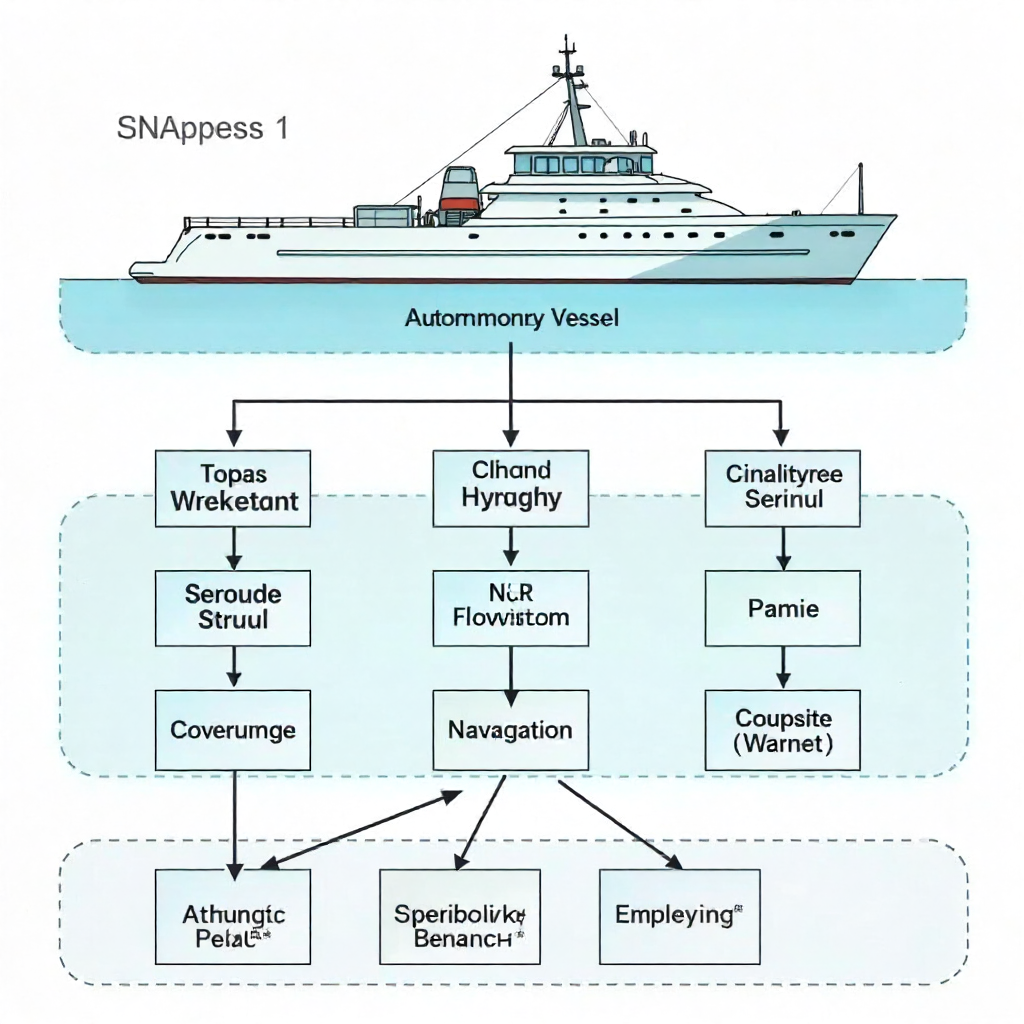
The Guidance, Navigation, and Control (GNC) architecture provides the layered framework within which all ASV control algorithms operate. Guidance generates the desired trajectory or waypoint sequence; Navigation estimates vessel state from sensor data; Control executes actuation commands to track the guidance output.
These three layers interact continuously, but they are not equivalent in computational priority. Navigation runs at the highest frequency—typically 10–100 Hz depending on sensor suite—because state estimation errors propagate rapidly into guidance and control decisions. Guidance operates at a slower cadence, replanning paths on the order of seconds. Control closes the loop at actuator-appropriate rates.
What makes modern GNC design challenging is that the separation of concerns implied by this layered model breaks down in practice. A replanning event in guidance forces the control layer to handle large reference step changes. Sensor fusion failures in navigation corrupt the state estimates that both other layers depend on. Designing for graceful degradation across all three layers simultaneously is an active area of research that the naval engineering community has not fully resolved.
Model Predictive Control and Trajectory Optimization
Model Predictive Control (MPC) is the dominant paradigm for ASV trajectory optimization because it handles constraints explicitly and optimizes over a finite prediction horizon—capabilities that are essential in congested or dynamically changing maritime environments.
The core appeal is constraint handling. An MPC formulation can simultaneously enforce actuator saturation limits, minimum safe distances to obstacles, heading rate constraints, and energy budgets within a single optimization problem. No classical PID architecture can do this directly. For a vessel operating near port approaches or in confined waterways, this matters significantly.
The trade-off is computational cost. A nonlinear MPC (NMPC) problem with a 30-second prediction horizon and 1-second control intervals involves solving a nonlinear program every second—feasible on modern embedded hardware, but with limited margin for model complexity. Linearized MPC reduces the computational burden at the cost of prediction accuracy, particularly in high sea states where nonlinear hydrodynamic effects dominate.
Recent work has focused on stochastic MPC formulations that incorporate probabilistic sea state forecasts, allowing the vessel to plan paths that remain feasible under a distribution of environmental conditions rather than a single worst-case estimate. This direction is promising for offshore survey and patrol applications where mission endurance matters more than point-to-point speed.
Adaptive and Robust Control for Uncertain Marine Environments
Adaptive and robust control algorithms address the fundamental problem that no hydrodynamic model perfectly captures real vessel behavior across all operating conditions. The distinction matters: robust control designs for worst-case bounded uncertainty without updating the model, while adaptive control actively updates model parameters based on observed discrepancies.
For ASVs, adaptive schemes are particularly valuable during extended missions where biofouling, cargo shifts, or equipment degradation alter vessel dynamics over time. A fixed-model controller designed at mission start may accumulate tracking error as the actual vessel response drifts from the nominal model. Online parameter estimation—using recursive least squares or model reference adaptive systems (MRAS)—allows the controller to track these slow drift processes.
Robust control, by contrast, is better suited to fast-timescale disturbances: wave forces, propeller wash interactions, and current gusts. H-infinity and sliding mode approaches are commonly used here, and both have been demonstrated on physical ASV platforms. The engineering compromise is conservatism: a robust controller designed for a large uncertainty set will sacrifice performance in nominal conditions to guarantee stability at the boundaries of that set.
Combining both paradigms—using adaptive identification to shrink the uncertainty set that the robust controller must cover—is an active research direction that merits dedicated sessions at symposia focused on ship control systems.
Reinforcement Learning and Data-Driven Approaches
Reinforcement learning offers the theoretical promise of discovering control policies that outperform hand-engineered solutions in complex, poorly modeled scenarios—but its deployment in safety-critical maritime systems remains limited and, frankly, not yet mature enough for unsupervised open-ocean operation.
The core appeal for ASV applications is generalization. A well-trained RL agent can, in principle, learn to exploit hydrodynamic phenomena that are difficult to model analytically, such as wave-riding for energy efficiency or current-assisted path optimization. Simulation-to-reality transfer remains the primary obstacle. Training environments rarely capture the full bandwidth of real sea state disturbances, and policies that perform well in simulation can degrade sharply when deployed on physical vessels.
Safe RL frameworks—incorporating Lyapunov-based safety constraints or constrained policy optimization—are beginning to address the certification gap, but no recognized maritime standards body has yet defined a qualification pathway for learned controllers in Class-certified autonomous vessels. Until that gap closes, the practical role of RL is likely to remain confined to advisory functions within a broader GNC architecture, with model-based controllers retaining authority over safety-critical maneuvers.
COLREGs Compliance and Autonomous Collision Avoidance
COLREGs compliance is the regulatory and algorithmic problem that most directly distinguishes ASV control from other autonomous systems: an ASV must not only avoid collisions but do so in a way that a human watchkeeper on an encountering vessel would recognize as legally compliant behavior.
Rules 13 through 17 of COLREGs define overtaking, head-on, and crossing scenarios, each with specific obligations for the give-way and stand-on vessel. Encoding these rules into a real-time decision system requires disambiguating the encounter geometry from noisy sensor data, classifying which rule applies, and executing the mandated maneuver within a time window that varies with closure speed and sea room.
Velocity Obstacle (VO) methods and their extensions—reciprocal velocity obstacles (RVO), nonlinear velocity obstacles—provide a geometric framework for computing COLREGs-compliant avoidance trajectories. These approaches work well for single-encounter scenarios. Multi-vessel encounters, where multiple obligations may conflict, are significantly harder and represent an open research problem that the community has not resolved through any single algorithmic approach.
Hybrid architectures—combining rule-based COLREGs logic with optimization-based path planning—are currently the most practically viable approach. The rule layer handles scenario classification and obligation assignment; the optimization layer finds an efficient trajectory that satisfies those obligations given current environmental conditions and vessel dynamics.
Outlook: Open Problems and Directions for the Naval Engineering Community
Several problem areas remain genuinely unsolved and deserve focused attention at the next INEC and related ship control systems symposia. These are not incremental refinements—they represent fundamental gaps between current algorithm capability and real-world operational requirements.
Sensor fusion under degraded conditions is the most operationally urgent. GPS denial, radar clutter in confined port approaches, and LIDAR performance in heavy precipitation all create scenarios where the navigation layer receives degraded or conflicting data. How the GNC architecture should detect, characterize, and respond to sensor degradation—without defaulting to conservative stops that compromise mission value—is not well addressed in current literature.
Multi-vessel coordination presents a different class of challenge. Single-ASV control is difficult; coordinating a fleet of autonomous surface vessels to execute a cooperative mission—distributed survey, convoy escort, search and rescue—while maintaining COLREGs compliance across all pairwise interactions requires distributed control frameworks that scale gracefully with fleet size. Current solutions either centralize too much computation or sacrifice optimality significantly.
Certification pathways remain the longest pole in the tent. The IMO Maritime Autonomous Surface Ships (MASS) framework provides a regulatory vocabulary but does not yet define technical requirements for algorithm qualification. Engineers submitting work to conferences like INEC have an opportunity—and arguably an obligation—to engage with this gap directly, proposing verifiable performance metrics that could inform standards development.
The field is advancing, but the distance between laboratory demonstrations and unrestricted autonomous operation at sea remains substantial. That gap is precisely where the naval engineering community's attention is most needed.
Frequently Asked Questions
What is the difference between adaptive control and model predictive control in ASV applications?
Adaptive control updates the vessel model in real time to compensate for parameter drift, while MPC uses a fixed model to optimize a control sequence over a prediction horizon with explicit constraint handling. In practice, they address different problems: adaptive control handles slow model uncertainty; MPC handles trajectory optimization under known constraints. Many advanced ASV systems use both in a layered architecture.
How do autonomous surface vessels handle COLREGs in real-time scenarios?
Most current ASV systems use hybrid architectures that classify the encounter geometry into a specific COLREGs scenario, assign give-way or stand-on status, and then invoke an optimization-based planner to compute a compliant avoidance trajectory. Multi-vessel encounters—where obligations may conflict—remain an open research problem without a widely accepted solution.
Can reinforcement learning be safely applied to maritime control systems today?
RL can be safely deployed in advisory or supervisory roles within a broader GNC architecture, where a model-based controller retains authority over safety-critical maneuvers. Fully RL-driven ASV control is not yet ready for unsupervised open-ocean operation, primarily due to simulation-to-reality transfer limitations and the absence of recognized certification pathways for learned controllers.
What sensor fusion approaches are most common in ASV guidance systems?
Extended Kalman Filters (EKF) and Unscented Kalman Filters (UKF) are the workhorses of ASV state estimation, typically fusing GPS, IMU, radar, and LIDAR data. Factor graph-based approaches are gaining traction for scenarios requiring longer-horizon consistency, such as simultaneous localization and mapping (SLAM) in GPS-denied environments.
How does dynamic positioning differ from full autonomous navigation in surface vessels?
Dynamic positioning (DP) systems maintain a fixed position or heading against environmental disturbances—a regulation problem with a stationary setpoint. Full autonomous navigation requires path planning, obstacle avoidance, COLREGs compliance, and goal-directed routing. DP is a solved problem with well-established certification standards; full autonomy is not. Most current autonomous surface vessels use DP-class controllers as the inner control loop within a broader autonomous GNC architecture.